


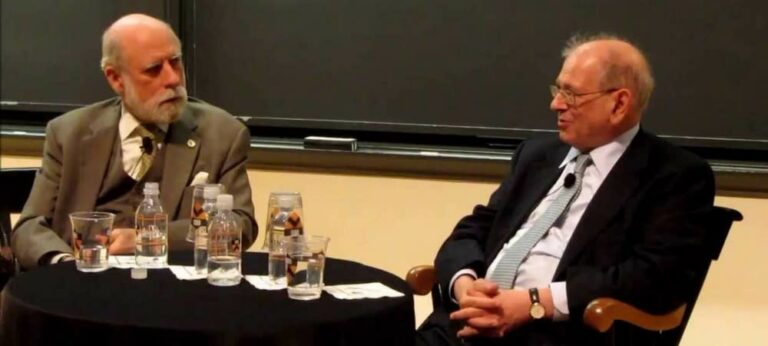
The Assoprovider saga continues, narrating the stories of the founders of the Network. This installment features Robert Kahn and Vint Cerf, the inventors of the TCP/IP protocol that enables the exchange of information on the web.
I am in the Inventors Hall of Fame, on par with Edison and Marconi. Vint Cerf and Robert Kahn are the inventors of the TCP/IP protocol, the language that today enables the exchange of information on the Network. Their invention has completely revolutionized the history of the web and given life to the Internet we know today. Yet only a few, the experts in the field, know their history and the role they play in the development of the web. However, the lack of international fame has never been a problem for them:
"More than three billion people use the Internet. This is important, not that they know who we are. It is still fantastic to have been there from the beginning and to be associated with something so important.", they declared to the press.
The meeting between two geniuses
Robert Kahn and Vint Cerf both study at prestigious universities, one at Princeton, the other at Stanford. They are two brilliant computer scientists and thanks to their talent, they are involved in the major events that form the first core of the Internet.
Their meeting takes place within IPTO (Information Processing Technique Office) is a department born from an idea by ARPA, the research agency managed by the American Department of Defense started in 1958.
The first official mandate of ITO is to find solutions that would allow the interconnection of the main sites for RADAR air defense. The first wide area network created by the agency is indeed Arpanet, the progenitor of the current Internet.
As part of this project, the idea of IMP is launched. Acronym for Interface Message Processor, it is the first device that allows the interconnection of different computers, regardless of the manufacturer type and the type of operating system used. The protocol used goes down in history as NCP, Network Control Protocol.
Despite the revolution that NCP brings in connecting devices on the Network, it shows many limitations, and it is precisely from these that Vint Cerf and Robert Kahn start to revolutionize the model.
To develop the protocol in the best way, the INWG, International Working Group, is established., within which Cerf and Kahn work side by side during crucial years for the history of the web, from 1973 to the late Seventies. The two coordinate an international work team that brings to life a new protocol, TCP/IP. Here's how it works and why it changed the history of the Internet.
In 1973, a new transmission procedure was born
The system devised by Kahn and Cerf allowed precise communication between computers, minimizing the errors and difficulties that occurred with the NCP, especially in the sending and receiving of data.
The protocol must be defined as a combination of two IT procedures. On one side, there is TCP, an acronym that stands for Transmission Control Protocol. What does TCP do? In simple terms, it manages the organization of data and their transmission. Data is broken down into smaller packets and then reassembled when they reach the computer they are intended for.
For TCP to function, it must be linked to IP (Internet Protocol), the other protocol that allows each computer to be identified by a number (composed of numerical blocks). This makes it possible to accurately determine which electronic device is connected to the Network and provides the destination address for the data.
To understand the scope of the revolution, just consider that with TCP/IP today it is possible to interconnect not only computers but any type of device, from printers, phones, robots, cameras. Without TCP/IP, there would be no Internet as we know it and all its derivatives like The Internet of Things.
The enlightening phrases of two geniuses
Kahn and Cerf still hold strategic importance for the Internet today, collaborating with universities and companies. Cerf, for example, was hired by Google in 2005 as Internet Chief Evangelist. Over the years, the two have continued to participate in the evolution of the Internet, often providing enlightening statements on what it should be. the role of the web in society. We have collected some.
"No one has a crystal ball and can see the future. What the Internet will become depends on what society decides to do with it. The Internet is a microcosm of society." R. Kahn.
"The flow of information is what the Internet represents. The form of the Internet is in sharing. If you do not share your idea, people will not be able to do anything good with it, and you will remain anonymous and powerless."V. Cerf.
"I am not happy with the spam and viruses that overwhelm the Internet today. However, I remain confident and believe that technology has antibodies within itself and will be able to solve most of the problems it causes." R. Kahn.
"One year in the life of the Internet is like a year in the life of a dog: equivalent to seven years of our lives. This is the speed at which the Internet evolves today.". V.Cerf