




What does resolution 156/23/Cons provide? Let's explore the regulations intended for fixed-location Internet operators in terms of pre-contractual transparency, contractual transparency, and KPI.
New webinar by Assoprovider: together with engineer Alfredo Pasini, the association's consultant for regulations, we recorded an event on November 15 titled
“The new regulation on pre-contractual and contractual transparency and quality indicators for fixed-location electronic communication services (resolution no. 156/23/Cons).”
Objective: to stay updated on recent regulatory changes in the field, providing providers with concrete tools to navigate the new provisions.
The works are introduced by Assoprovider vice-presidents Antonella Oliviero and Marcello Cama.
To review the full recording of the event, visit Assoprovider's official YouTube channel:
The new KPI (Quality Indicators)
First of all, we start with the rationale of the regulation, so why are the quality indicators being updated? There are four main reasons:
- Conformation: The standards for evaluating the quality of fixed telephone and Internet services have been updated according to the latest government regulations.
- Simplification: The quality indicators have been reduced from 21 to 10, eliminating those no longer useful, such as the response time of directory inquiry services, the percentage of payphones, and the provisioning time for carrier pre-selection.
- Regulatory Unification: Instead of many different rules, there is now a single regulation for fixed telephone and Internet services, replacing various resolutions.
- Technological Upgrade: The standards have been updated to accommodate modern high-speed Internet connections.
With the new resolution 156/23, 10 new Quality Indicators are established. Let's explore them to understand how the regulations have evolved compared to previous regulations:
- Complaints about charges (which replaces Disputed Invoices and Disputed Charges);
- Billing accuracy, which was previously only for voice service, not for Internet;
- Activation time del servizio (che sostituisce Tempo di fornitura dell’allacciamento iniziale e Tempo di attivazione del servizio);
- Failure rate (which replaces the Fault Rate for access line);
- Repair time malfunctions;
- Call failure probability;
- Call setup time;
- Data transmission speed;
- Data transmission delay;
- Packet loss rate.
Let's make some clarifications for the two KPIs "Call Failure Probability" and "Call Setup Time": both are only applicable to voice services and, in any case, the 156/23 currently provides that they are optional (we will explore how in the next paragraph), because it is not excluded that they may be eliminated in the future, after a study period by the Authority.
The last three, finally, are typical of Internet access service and are also under evaluation. This is not because they will become optional, but on the contrary, they will be among the most influential: for example, they will be used for contractual compensations, which we will discuss later. Along with the service activation time, they currently represent the four most important parameters.
Information and transparency obligations applicable to contracts
L’articolo 5 della delibera impone poi una serie di obblighi di trasparenza sulla qualità dei servizi, a tutti i fornitori di servizi di comunicazioni elettroniche da postazione fissa, anche in tecnologia FWA (e questa è una novità introdotta proprio dalla delibera 156/23).
The provider is required to submit semi-annual and annual reports to the Authority on the results actually achieved, based on the indicators (from 2 to 8) mentioned in the previous paragraph:
- The report for the second semester by March 31
- The report for the first half by September 30
- The annual report, concurrently with the publication of the annual financial statements, or in any case by June 30 of the following year
Per inviare i dati, esiste un apposito modello elettronico sul sito web dell’Autorità, disponibile al link: Agicom
Together with the annual report, an annual statement with all the necessary information on: must also be sent to the Authority.
- Indicators
- Measurement methods
- General standards set for indicators
- Actual results achieved in the reference calendar year
All reports and statements must also be published on the provider's official website, within the same time frame already established for communication to the Authority.
Engineer Pasini then makes an important clarification regarding indicators 7 and 8, which, as we have seen, are considered optional. In reality, further analysis by AgCom is necessary, which, by acquiring and evaluating the values of the indicators on the operators' networks, will make a final decision on the matter. Therefore, operators must also send the measurement values of indicators 7 and 8 on a significant sample of outgoing traffic by January 31, 2024.
Implementation of Internet access service quality measures
Resolution 156/23 then requires the obligation to send the information indicated in annex 1 of the regulation to the Authority for each subscribable offer. This information must also be reported on a dedicated page on one's website, called the "technical transparency page."
Here is the information to be included on the page, in a table created by engineer Pasini:
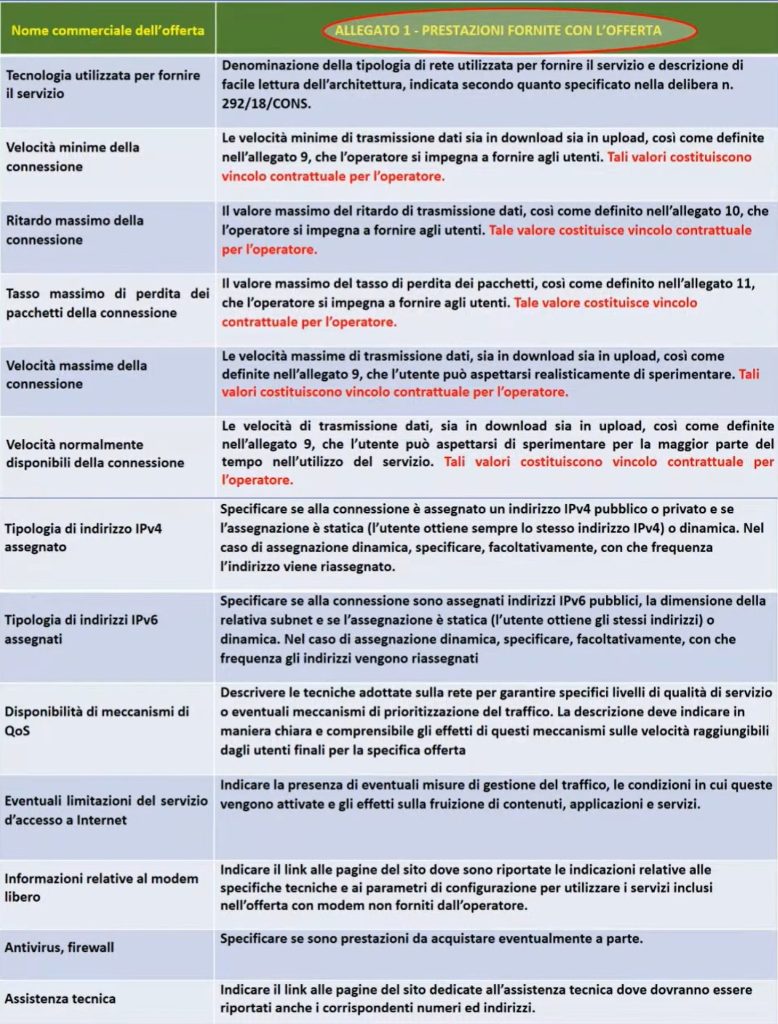
Subsequently, engineer Pasini outlines the information to be included at the contractual level as required by Article 4 of the resolution.
Before the consumer signs a contract, the operator must provide information regarding the characteristics and performance of each offer.
Specifically, the technology used and the minimum characteristics must be indicated (always following the model of annex 1 of the regulation).
Resolution 156/23 then requires the obligation to send the information indicated in annex 1 of the regulation to the Authority for each subscribable offer. The operator must also include, in the contractual proposals, the information provided for in Article 4, paragraph 1 of Regulation EU 2015/2120 and the "service activation time" (according to annex 4 of the resolution).
What information is required by the EU Regulation?
- How the actions of the Internet provider affect the quality of service, user data privacy, and security.
- What happens when the speed and amount of data usable on the Internet are limited, and how this impacts the use of websites and apps.
- What are the effects on the user's Internet services when choosing specialized services for certain types of content or apps.
- Information on the Internet speed provided (both slow and fast) for fixed and mobile networks, and how differences from the promised speed can affect users' rights.
- What consumers can do if the actual Internet speed or quality does not match what was promised (possibility of appeal by the user).
Among the most important aspects, Pasini recalls that the resolution obliges operators, during the contractual phase, to present information on KPI 9, 10, and 11:
- 9 – data transmission speed (minimum, maximum, and normally available download and upload connection speeds);
- 10- data transmission delay (maximum connection delay);
- 11- packet loss rate (maximum packet loss rate of the connection).
By providing this information, operators commit to complying with them; therefore, the contract must also specify the rights of consumers when the quality levels indicated in the contract are not met.
Deadlines
Recapping what has been discussed so far, what must operators do and, most importantly, when?
- Starting from the first half of 2024, operators must use indicators from 2 to 8 to define objectives and detect quality results;
- By January 31, 2024 operators must implement the provisions of the Resolution, excluding the information contained in the Guidelines that will be defined by the technical committee established by AGCOM;
- Technical table to be concluded by December 31 di quest’anno: le Linee Guida definiranno le modalità di misura degli indicatori di qualità;
By April 30, 2024, it will be necessary to publish on websites and in contractual documentation the maximum and normally available speeds, contractual indemnities related to minimum speeds, the maximum transmission delay, and the maximum packet loss rate.