


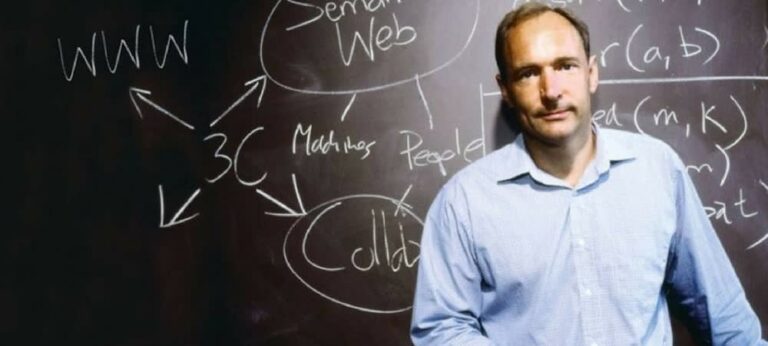
Why is the interoperability of systems and platforms important? Assoprovider dedicates in-depth analyses to those who have made the history of the Internet. The first protagonist is Tim Berners-Lee, the inventor of the World Wide Web.
"Losing the past means losing the future" (Wang Shu)
To innovate, one must know what came before. Any company or startup that wants to innovate in the digital world cannot "do without the past."
It is precisely starting from this truth that AAssoprovider has decided to create an event dedicated to remembering the deeds of the founding fathers of the Internet.: without their commitment and ingenuity, the world we know today would never have existed.
And also our work as provider it would be quite different.
The first episode of our journey is dedicated to Tim Berners-Lee. Here's everything you need to know about the inventor of the World Wide Web.
Tim Berners-Lee: origins of one of the fathers of the Internet
He inherits his passion for high-tech from his parents, two mathematicians who work with the Ferranti Mark 1, one of the first commercial computers in history. Young Tim is captivated by it.
After graduating in physics, his love for technology takes over. His first job is as an engineer at a telecommunications company in the southeast of England. His first invention was in 1978: it was software for printers.
The turning point comes a few years later when he is called to work as an external consultant at CERN. It is there that he proposes a project that simplifies the sharing of information among the various researchers of the institute. It is called Enquire and it is the first hypertext client in history, a first prototype of what will be the invention to which it owes all its success.
The World Wide Web was born out of frustration
After a few years, Tim returns to CERN in 1989 and will make history. He works on further developing Enquire, a project aimed at creating an interconnected computer network to insert hypertext pages. The feeling that drives him to do so is frustration, as he himself explains in this interview with Business Insider, of which we provide an excerpt:
"I remember the frustration I felt at every meeting: every document had to be printed or copied onto a disk and transmitted to another computer." What irritated me the most was the lack of interoperability between systems."
The interoperability of systems is still a determining factor today and represents a principle that has always guided Assoprovider's actions because the lack of interoperability, among other things, would hinder the proper development of competition and thus would be an obstacle to innovation.
In the same interview, Tim also discusses the solution to the problem he devised, to connect the computers of research centers and share information, a sort of online database accessible from every computer.
"Much of the technology we used already existed, such as hypertexts and the Internet. What we did was put these ingredients together to make them work. It was a job."
Tim is not the first to understand the need for a common space to share documents among researchers. Others were also trying. Why did they fail while he succeeded? For two main reasons:
- For the decentralized approach. While others were building systems that only worked on certain operating systems, like IBM, Tim understood that the sharing network should function without forcing users to change the operating systems they were accustomed to.
- For the free offer. Some protocols at the time were even more successful than Tim's idea, but they were designed to charge royalties to users. From the very beginning, Tim conceived his software as a system open to everyone.
The first protocol of what later became the World Wide Web was presented in 1989, with a subsequent implementation in 1990. After receiving a positive opinion from CERN, the computer science genius, in collaboration with Robert Cailliau, also designs the first web browser and the first web server. Then, three other extraordinary inventions will follow:
1) The HTML language
2) The http protocol
3) The URLs
In 1991, the first website in history was created: info.cern.ch. What's inside? The first page contains information about the WWW project and explains in technical detail how to create your own web page.
Internet and the Future: The Most Beautiful Quotes by Tim Berners-Lee
Today Tim is 62 years old. In his career, he has been awarded a multitude of titles and honors. The most recent, and we are sure one of the most appreciated, is the Turing Prize, the Nobel Prize for computing, which was granted to him for the invention of the "World Wide Web, the first browser, and fundamental protocols and algorithms for the expansion of the Network."
In addition to the legacy he provided us, Tim has also offered over the years many pearls of wisdom on the true meaning of the Internet and the challenges it will face in the future. We have collected some of them.
"The web as we imagine it does not yet exist. The future is always broader than the past."
Read here for more information: The Internet of the future will be like this: 5 trends to watch
"When a tool offers such wide margins for creativity, like the web, the only limits are in our imagination."
"We cannot blame technology for our mistakes."
"We need diversity of opinions in the world to tackle the challenges of the future."
"The information is the most valuable thing and will last longer than the systems that contain it."