



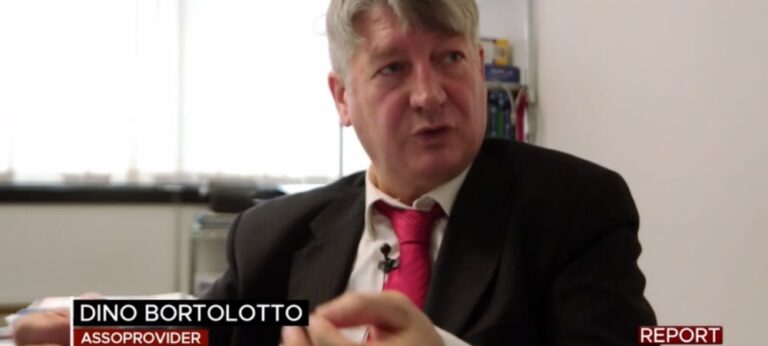
How to bring bandwidth to everyone in an innovative and cost-effective way? This is one of the questions answered by two members of Assoprovider, President Dino Bortolotto and councilor Marco Liss during a Report investigation on broadband in Italy.
The investigation conducted by the television program team is a denunciation of the inability of major players, primarily Tim, to ensure fiber access for everyone. After ten years, in fact, and investments of approximately two billion in public funds and eight billion allocated, the offer of broadband for everyone is still a dream.
Theinvestigation aired on Rai Tre, reveals all the dark sides, the waste of public money, and finally offers some alternatives through the voices of our representatives.
What is Fixed Wireless Access
Fwa, acronym for Fixed Wireless Access, is a technology that has grown in recent years. What does it allow? It guarantees ultra-broadband performance through radio frequencies, with lower costs and times compared to similar solutions, those based on fiber or copper/fiber.
The market was born following the Landolfi decree in 2005, which liberalized the 5 GHz frequencies. However, the growth of this channel is hindered by the cost of licenses in our country, as Liss reported to Report:
Unlicensed wireless is a valid alternative to the copper last mile. It allows the delivery of even 100 megabits with performance very similar to fiber optics. The difficult part is due to the fact that licenses for backhauling routes are among the most expensive in Europe, at least 10 times more. And 10 times higher than the expenses paid by television operators to use the same licenses."
This is where the paradox arises, highlighted by the journalist who conducted the investigation:
"Why charge so much for licenses that, due to excessive costs, are not purchased and do not bring money into the State's coffers?"
The agreement with small operators

Another opportunity to extend the use of broadband and not waste public money is suggested by Dino Bortolotto. The president of Assoprovider thus describes the alternative path to Report:
"One possibility is for the major fiber players to reach agreements with small operators and extend the fiber where it is needed.", up to the repeaters, and then integrate it with a radio signal. In this way, state investments could be leveraged to provide those "missing pieces" and bring benefits to communities, including those in market failure.»
A real alternative to today's model, where "we use public funds to equip territories with infrastructure, without allowing the people living in those areas to actively intervene and identify the zones where there is the greatest need for fiber, thus optimizing investments."
The cooperative model to bring ultra-broadband
Moreover, the battle for "broadband" has been fought for years by the association, which has been very active on this front in recent months. This is evidenced by the agreement made with Legacoop to distribute broadband with fiber optics in market failure areas.
"This agreement is the 'offspring' of the battles that Assoprovider has fought over the years to allow cooperatives to enter the market as communication operators and offer Internet services. With Legacoop, we support those citizens and businesses that organize into cooperatives to promote the distribution of ultra-broadband in market failure areas," explains Giovanbattista Frontera, Vice President of Assoprovider.
In the vision of Legacoop and Assoprovider, cooperatives will present themselves as purchasing groups for Internet services. As members of the cooperative, they will be able to enjoy several advantages. For example, having greater bargaining power with all operators, including the big players in the market, and more easily switching operators if dissatisfied with prices and service quality. The advantages also extend to the operators themselves, who will be able to compete without positional rents or monopolies.
To learn more you can read here