



After the guide for Municipalities on the new European Communications Code, series OpenTLC,
editions Consulservice and authors Eng. Alfredo Pasini and Arch. Di Cesare is always published by Consulservice:
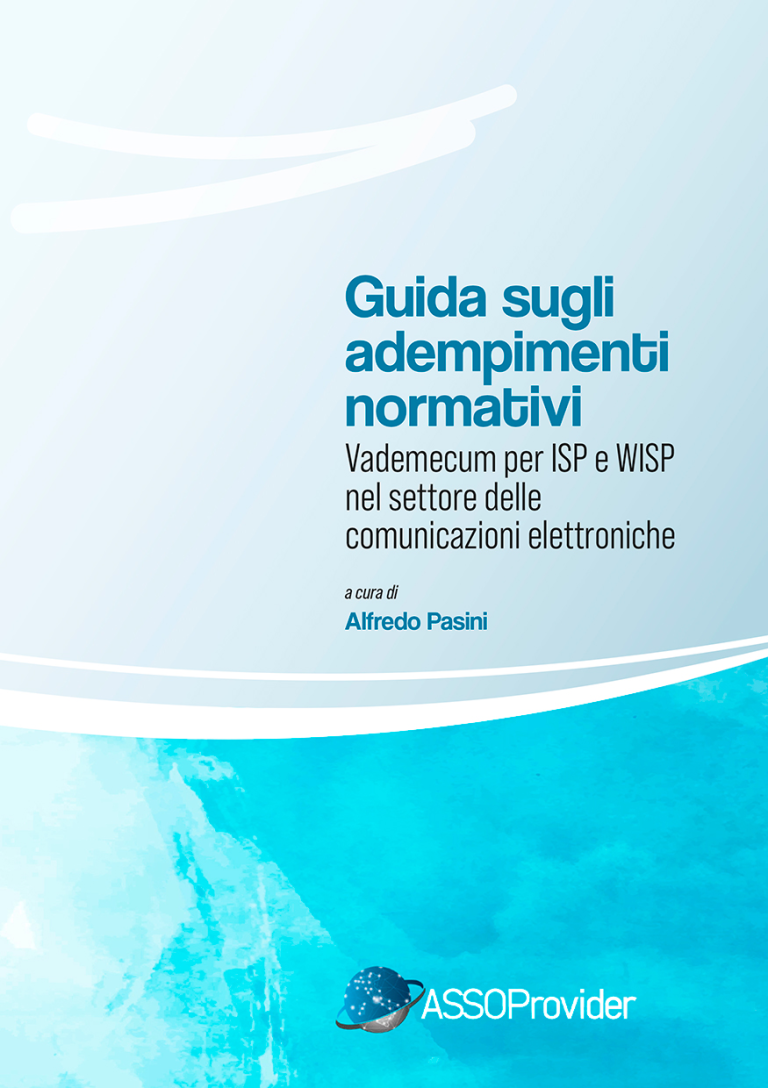
GUIDE ON REGULATORY COMPLIANCE
Vademecum for ISP and WISP in the electronic communications sector.
Autore Ing. Pasini consulente per le normative dell’associazione.
Il vademecum vuole aiutare l’ISP e il WISP negli adempimenti quotidiani.
The 122-page volume will be available by the end of the month at a cost of 35 euros (excluding shipping).
Distribution methods.
Amazon
Assoprovider Members
Assoprovider members, with a contribution of only 15 euros, including transportation costs, can request it from the publisher using the methods that will be communicated in the internal lists.
APPA22 participants
Tutti i partecipanti all’ evento nazionale #APPA22 from September 30 in Palermo will be able to collect it free of charge TOGETHER with the new version of the "Guide for Municipalities on the New European Communications Code”
Furthermore, it will be possible to purchase it from affiliated distributors.
Dall’autore
This text aims to be an easy-to-consult tool, through which operators offering Internet access and/or voice telephony can easily become aware of the legislative and regulatory provisions on the services they market daily. This will allow them to protect themselves from potential disputes – Ignorance of the law excuses not – and to become aware of their rights towards customers.
Its drafting involved considerable difficulties due to the fragmentation of regulations that have often overlapped and intersected over time, and it is well known that they are always in continuous evolution. For this reason, within the limits of possibility, the text will be constantly updated to adapt to a market like that of electronic communications services, which has been in continuous and constant technological evolution since the early years of its liberalization.
The document is divided into several chapters, dedicated to the main subjects that operators have to deal with daily, namely: authorizations, frequencies, service charters, activations/deactivations, compensations, remaining credit, service disruptions, billing, contractual changes, withdrawal, delays, suspensions, and contractual transparency.
To improve the intelligibility of the text, it has been decided to allow simplified consultation through the insertion of symbols of alert, web and data. In this way, the operator is notified when a compliance requirement is of primary importance, when it concerns the company portal, or when there is a deadline to meet. To all this, and for each topic addressed, references to the Authority's resolutions, national regulations, or articles of the Electronic Communications Code have been added so that everyone can further explore what is of most interest to them. Finally, the appendices referenced in the text have been included at the end of the work.
Ultimately, it is a tool that, due to the breadth of the topics covered, albeit in a concise manner, aims to fill a gap given the lack of documents expressly dedicated to operators, in light of the numerous similar initiatives promoted by various Associations and by the same Authority for Communications Guarantees rightly aimed at informing consumers and users of their rights.
SUMMARY
General obligations
SINFI electronic communication infrastructures
Administrative rights and rights for the use of frequencies
ROC – Register of Communication Operators – SCM Contribution
Service Charter
Contracts and relationships with users and consumers
Exercise of the right of withdrawal
Withdrawal and transfer of the user in adhesion contracts
Switching to another provider and number portability
Transparency of offers
Freedom of choice of terminal equipment
Quality of service
Complaints and compensation
Dispute resolution between users and operators
Network and service security – data retention
Provisions related to measures reserved for disabled users
Names of the different types of physical infrastructure