


Persistence is a magic word. Only those who know how to endure and do not give up, despite obstacles, achieve memorable results.
Persistence is one of Assoprovider's values, a beacon that guides our every action and has allowed us to winning many battles over the years to bring more justice and transparency to the telecommunications sector.
With the same spirit, the association will tackle this year, full of challenges for us and for all those who care about the fate of many small and medium-sized enterprises Italian companies, often crushed by unfair and harmful logics for the entire country.
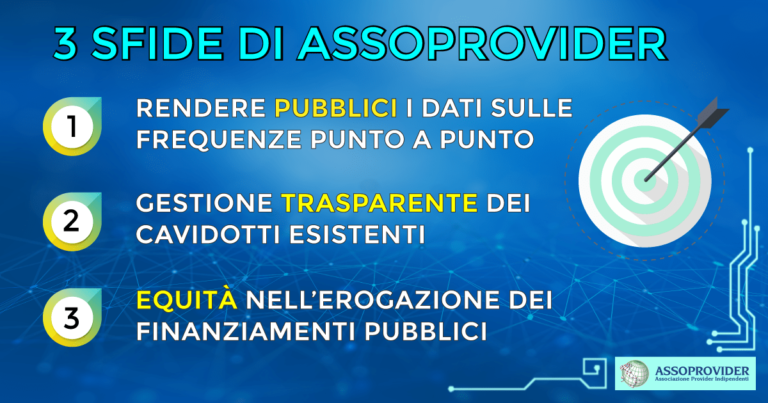
In this post, we tell you what are the three main fronts in which we will make available our determination and our expertise
1. End discrimination in point-to-point
"Italy is the country that charges the most for point-to-point connections, twice as much as Poland, which is the most expensive among the countries of the European Community. If I go to England, the same service costs a tenth for comparison. Internet service providers are not only the most economically disadvantaged because they are the only ones who pay the full contribution, but they are also disadvantaged in terms of the frequency assignment procedure. Our category is disadvantaged because it does not have the power, like others, to have tailor-made laws enacted.», is the statement from our president Dino Bortolotto (read the full interview here).
A real discrimination that the association wants to put an end to. For this reason, we will engage in dialogue with the Ministry of Economic Development to make data on point-to-point transparent, reiterating our counterproposal:
Equate the fee for the administrative contribution paid by Service Providers to the facilitated one of television operators.
2. Transparency in the use of the subsoil
It is the other great challenge of the association this year: the use of the subsoil. There are hundreds of ISPs digging to lay ducts or to use existing ducts to lay their fiber and are hindered by municipal administrations who have not yet adopted "the last 10 years of regulations regarding the reuse of the subsoil." As Dino Bortolotto explains:
"The problem is that there is no attitude consistent with the national legislative framework. Our colleagues face obstacles," such as the request for a guarantee, or they are put on hold for a phantom competition for an exclusive assignment. Imaginative interpretations that serve the interests of monopolists and oligopolists. It's a pity that the laws establish exactly the opposite, namely that it is not possible to offer the use of a public asset exclusively to one entity, but it must be granted to everyone under the same conditions," continues Bortolotto.
A sensitive issue to which another law is added, today disregarded by many with theEstablishment of SINFI (the national infrastructure registry, editor's note) the one that asks public administrations to provide data on their subsoil. Knowing, in fact, where the ducts are located small operators would save a lot of money on the excavation costs for laying fiber, offering advantages to the territories in terms of fast connectivity and reduction of the digital divide.
Assoprovider will send a letter to the 8,000 Italian municipalities, offering support in case there are difficulties in correctly interpreting the laws in force.
Furthermore, it will seek the assistance of Agicom and MISE to urge local administrations to provide their data to SINFI, and to manage the infrastructures transparently.
3. Equity in public funding in the sector
The other major topic is that of public funding in the sector. The Open Fiber case and similar ones show how it is necessary to use public funds more efficiently and distributed:
Instead of giving public funds to a single entity, and then trigger the subcontracting mechanism, wouldn't it be more useful to distribute the money to different entities, funding, for example, specific areas? This way, the waste of money that occurs by handing over the funds to the usual giants would be avoided," continues Dino Bortolotto.
Assoprovider's commitment to a more accurate management of public funding, will start from checking what has been done.
The association will request access to the documents and verify if there is a difference between what was funded and what was subsequently implemented.