


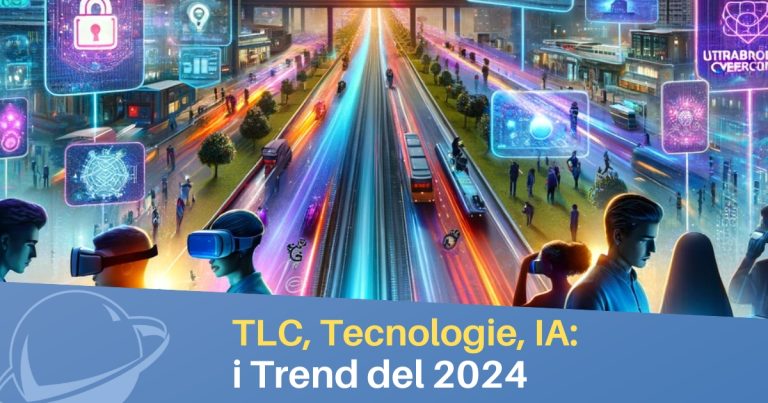
Discover the technological trends of 2024: AI, TLC, IoT, 5G, ultrabroadband, and the growing importance of cybersecurity and privacy.
2023 is likely to be remembered as the year when Artificial Intelligence definitively exploded, with applications impacting almost all market sectors.
But what will be the most interesting technological developments for Internet operators in 2024?
Let's explore some of the hottest trends: the evolution of AI, the fundamental role of Telecommunications (TLC) in the transition towards a greener future, the expansion of the Internet of Things (IoT) and Smart Cities, the progress of 5G and ultrabroadband, and the growing importance of cybersecurity and privacy.
AI: Artificial Intelligence
In the technological field, Artificial Intelligence has probably been the buzzword of this 2023, thanks especially to the launch of ChatGPT, which seems to mark a historical watershed, at least in the perception of the general public.
According to PwC, the contribution of AI to the global GDP will already exceed 15 trillion dollars by 2030, in just six years.
AI, or more correctly machine learning, impacts or will impact various aspects of corporate life in numerous sectors.
We can expect, for example, even greater automation of mechanical and repetitive tasks in the industrial sector, as well as implementation in the healthcare sector for early diagnosis, treatment personalization, and quality of care.
These are complex processes, which will necessarily be accompanied by the need to improve bandwidth to be implemented.
Specifically, AI can help optimize TLC networks by analyzing and managing data traffic more efficiently, allowing for the dynamic allocation of network resources to handle traffic peaks and reduce downtime.
Another sector particularly influenced by technology will be in cybersecurity. A sector in which investments are growing predominantly: 1.8 billion in 2022, with an increase of 63.6% over five years.
Telecommunications and Green Transition
According to the latest ESG Monitor, 82% of Italians claim to be interested in so-called ESG issues, namely environmental, social, and governance evolution. This figure has increased by 10% compared to the previous year.
It becomes essential for all companies (including in the TLC sector) to develop a strategy verde to not distance their positioning from the sensitivity of the average consumer.
It is important, for example:
- Employ renewable and sustainable energy sources as much as possible to reduce their environmental impact.
- Innovate data transmission technologies to improve energy efficiency by adopting more efficient modern technologies.
- Optimizing energy consumption, particularly in Data Centers, which are extremely energy-intensive devices, is crucial to maintaining high-quality network services. An example in this direction is more efficient cooling technologies.
- Overall sustainability in business operations, for example by using eco-friendly materials and reducing the production of waste and processing scraps.
IoT and Smart Cities
It is not news, but rather a confirmation: recent data they tell us that in 2022 the number of connected IoT devices grew by 18%, reaching 14.3 billion. A growth that is expected to continue this year, reaching 16.7 billion.
In particular, we see interesting applications not only in home automation and industry but also in precision agriculture and energy management. In this case as well, we are talking about processes that require fast and reliable connections to be enabled.
The same applies to investments in Smart Cities: according to Frost & Sullivan, this sector could generate business opportunities worth 2.46 trillion dollars as early as 2025.
IoT and smart cities are shaping the future of urban areas and the daily lives of citizens: operators will also have the opportunity to catch the train to create a more connected, efficient, and sustainable future.
5G and Ultrabroadband
Like it or not, 5G has now entered the common language of people, as well as their expectations in the field of mobile connectivity. According to a Ericsson report, subscriptions with this technology could globally reach nearly 2 billion by the end of 2024. A technology that, according to a Qualcomm report, could generate more than 13 trillion dollars in goods and services by 2035.
Regarding technologies, it is easy to foresee how the implementation of ultrabroadband connectivity will continue to grow, also because in Italy there is still significant room for maneuver due to persistent pockets of Digital Divide.
The photograph is taken by the "2023 Annual Report of AGCOM: at the end of 2022, there were 18.6 million broadband and ultrabroadband accesses in Italy (including business users). The households reached were still 52%. Alongside these, there are 5.5 million households (22.4% of the total) that connect only via smartphone and 2.5 million Italians who do not access the Internet from home in any way. It is also noteworthy that 30% of schools are not yet reached by ultrabroadband.
As we mentioned when discussing AI, 5G, and ultra-broadband are not just technological advancements, but they also channel change in various sectors, both corporate and otherwise. For this reason, it is crucial to reduce the Digital Divide, including the cognitive one, as quickly as possible.
Security and Privacy
There is one particular aspect that connects all the trends mentioned so far, which we have only hinted at: cybersecurity and privacy. In 2024, they will continue to be central themes in the current technological landscape, also due to the increase in cyber threats and the growing concern of individuals for the protection of their personal data.
Just consider that, according to the Clusit Report According to the Italian Association for Information Security, in the first six months of 2023, 1382 cyber attacks were recorded in our country, an increase from the 1240 in the same period of 2022.
If we broaden our view to the last five years, since 2018, we record a 300% increase in Italy alone, in stark contrast to the +61.5% globally: a sign that in our country, companies, institutions, and individuals are still not prepared for the cybersecurity challenge, making us vulnerable to ransomware, phishing, and data breaches.