


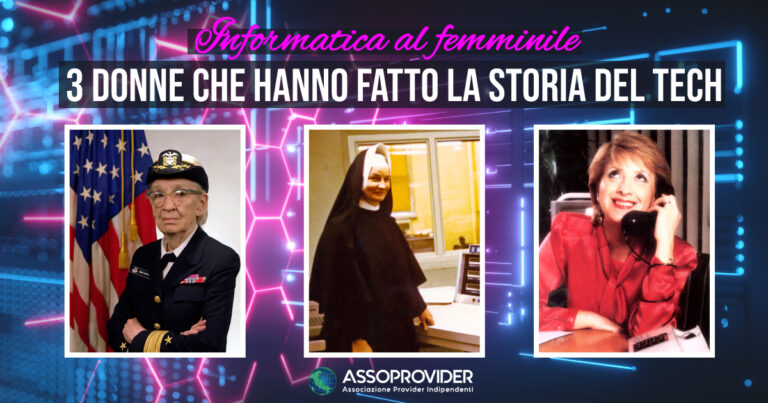
Computing is a man's business? Although it may often seem that way, in reality, there are many women who have made history in the Internet and in the informatica in general. Today, International Women's Day, Assoprovider wants to tell you the story of three Pioneers of the Internet, including a brilliant Italian.
Grace Murray Hopper (1906 – 1992)
It is practically impossible to overestimate the importance of Grace Murray Hopper in the world of emerging computing, starting from the 1940s and throughout her life. Suffice it to say that she invented the term bug, now very popular, and wrote the first computer manual in history. Hopper was literally the woman the U.S. Army turned to when they had computer problems to solve.
Born in New York in 1906, Hopper attended Vassar College and then Yale University, specializing in mathematics, a subject she later taught at Vassar, before joining the United States Navy in 1943. Her first assignment was at Harvard, in the Progetto di Calcolo office of armaments. Here, she works on the Mark I, the first large-scale automatic calculator, a precursor to electronic computers. It is precisely for the Mark I that she writes the first computer manual in history, the Manuale di Operazione per il Calcolatore Automatico a Sequenza Controllata: it is 1946. The invention of the term is also linked to this calculator. bug (which can also mean insect) by Hopper: a moth had indeed infiltrated the circuits of the Mark I, causing some problems.
After the war, he works at Eckert-Mauchly Computer Corp., where he also coins the term compiler, compiler (a program that "translates" instructions from symbolic languages into machine language), creating one of the first examples. In the same company, he worked on the design of UNIVAC I, the first commercial electronic computer in history.
Subsequently, she also created the first compiler in English, Flow-Matic, in 1957, which later inspired the development of one of the first programming languages, COBOL (common-business-oriented language), to which she herself contributed.
She was also recalled by the Navy in 1966 to assist with the standardization of naval computer languages: thanks to her services, she was first promoted to commodore and finally to rear admiral in 1985.
Paradoxically, this extraordinary woman was awarded the first "Man of the Year" in computing by the Data Processing Management Association in 1969. In 1991, she also received the National Medal of Technology and, posthumously, the Presidential Medal of Freedom in 2016, the highest honor awarded in the United States.
Mary Kenneth Keller (1913 – 1985)
Born in Cleveland, Ohio, in December 1913, Mary Kenneth Keller is a Catholic nun of the Sisters of Charity, where she entered in 1932, later professing her perpetual vows in 1940. Sister Mary Kenneth Keller is also considered as the first woman to receive a doctorate in informatica in the history of the United States.
Her studies begin at DePaul University, where she earns a bachelor's degree in mathematics and then a master's degree in mathematics and physics. It is in 1965 that she specializes in computer science, becoming a doctor at the University of Wisconsin. Her doctoral thesis concerns the construction of algorithms based on computation through analytical differentiation.
Per lei, l’università di Dartmouth abolisce la regola che vuole solo studenti, professori e ricercatori uomini, permettendole di lavorare al proprio centro informatico, il prestigioso Computer Center. In questo innovativo laboratorio, suor Mary Kenneth Keller collabora attivamente allo sviluppo del linguaggio di programmazione BASIC (Beginner’s All-purpose Symbolic Instruction Code), nel 1964.
After completing his doctorate, he then begins working at Clarke College in Dubuque, Iowa: here he dedicates 20 years to training the new generation of American computer scientists, particularly by creating the university's computer science department, of which he will be president for two decades, and a study program for the application of computers in education.
«For the first time – explained Kenneth Keller in a prescient quote of his – we know how to mechanically simulate the cognitive process. We can conduct studies in the field of artificial intelligence. Moreover, this mechanism [the computer, ndr] can be used to assist humans in learning. Over time, we will have more and more mature students in the field: teaching [of computer science, ed.] will therefore become increasingly important».
Marisa Bellisario (1935 – 1988)
“Her commitment is a symbol of the affirmation of gender equality in women's history.", words spoken by the then President of the Republic Francesco Cossiga dedication to Marisa Bellisario, an Italian pioneer in computer science.
Bellisario was born in 1935 in a small town in the province of Cuneo, Ceva. He graduated in Economics and Commerce and found his first job in the electronics world at the legendary Olivetti: it was 1959.
The following year, is invited in Milan to attend the first course for computer specialists, organized by the company founded by Adriano: this is one of the company's strategies to enter the electronic computing sector. Bellisario is thus part of, among the few women, the first generation of Italian IT specialists, in the role of a systems analyst, responsible for system support and application startup.
Olivetti's first concrete project in the sector is the ELEA 9003, the Electronic Arithmetic Processor: it is the first computer designed and produced in Italy. Bellisario plays a leading role in the project: she is indeed the programmer on the design mainframe.
We have recounted the story of ELEA 9003 here: When Olivetti Beat IBM: The Story of the First Transistor Computer
Shortly thereafter, from a "simple" analyst, she will become one of the first female managers in the history of tech (not only in Italy). Unfortunately, ELEA represents one of the few successes of Olivetti's computer research. In 1960, Adriano dies, and the company's financial difficulties become insurmountable. The electronic division of the company is then sold to General Electric, giving rise to OGE (Olivetti General Electric).
It is within this framework that Marisa Bellisario becomes a product director, among the few top executive of the global IT sector. Out of respect for him, meetings with the American company begin with a "Marisa and gentlemen”.
In 1972, the manager returned to work at the headquarters as Director of Operational Planning, before some conflicts with the new management of Carlo De Benedetti did not bring her back into the Stati at Olivetti Corporation of America (OCA), the American subsidiary of the Ivrea-based company that is in dire economic straits. In 1979, Bellisario manages to bring OCA back to profitability. Fortune celebrates her as a woman "that made itself, a manager who for the newspaper still represents a “rarity, at the time.
After a brief assignment in the agreement between Olivetti and StGobain, Bellisario leaves the company to become co-general manager of Italtel, a leading telecommunications company, which is also in dire conditions due to Italian competition from American (ITT, GTE) and Swedish (Ericsson) technology in the telephone sector.
Having become the CEO of the group controlling Italtel, Bellisario develops a recovery plan that yields incredible results within a few years, such as a +30% increase in revenue in 1982. In 1985, the CEO can announce that Italtel “produces wealth instead of losses”, becoming one of the leaders in the electronics sector in Italy during those years.
To delve deeper into the topic, also read: 5 women who made Internet history