

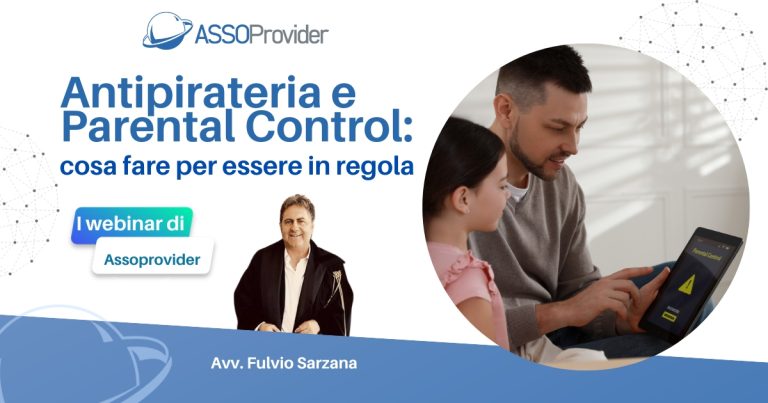
New Assoprovider Webinar for members: with legal expert Fulvio Sarzana di S. Ippolito, we discuss the appeal to the Tar regarding anti-piracy regulations and the provisions on Parental Control, to be activated by November 21.
Assoprovider has decided to appeal to the Tar to contest the amendments to the Regulation in copyright law and the premises of the same regulation, namely law 93 of July 14, 2023, on anti-piracy, which came into force last August 8.
This is the news at the center of the first slot of this new webinar by the association of independent internet providers, featuring reflections by lawyer Fulvio Sarzana di S. Ippolito, broadcast live on YouTube and LinkedIn on Tuesday, October 17.
Subsequently, the reflection shifted to Parental Control, what are the obligations for providers and the technical solutions for implementing it, proposed by Assoprovider partners.
The meeting was introduced and moderated by the vice presidents of Assoprovider, Antonella Oliviero and Marcello Cama.
You can review the full recording of the webinar on Assoprovider's official YouTube channel:
<iframe width=”1520″ height=”570″ src=”https://www.youtube.com/embed/70HCss_oHTE” title=”APWeb1023 – Parental Control what to do to be compliant” frameborder=”0″ allow=”accelerometer; autoplay; clipboard-write; encrypted-media; gyroscope; picture-in-picture; web-share” allowfullscreen></iframe>
Anti-piracy, the appeal filed with the Tar by Assoprovider
Lawyer Sarzana introduces the proceedings by explaining the reasons behind the appeal to the Tar filed against the new anti-piracy regulations:
«One thing must be absolutely clear: Assoprovider is not in favor of piracy; on the contrary, it supports authors and performers. However, this does not mean that providers should undertake the task of investigating illicit activities commissioned by third parties that have nothing to do with their own networks. This is the issue that Assoprovider has always highlighted and has led us to the appeal submitted to the Tar.».
Above all, the lawyer emphasizes, the timeframes required of providers for blocking access to content that violates copyright are unacceptable (let us recall, 30 minutes from the notification received).
«Incompatible timelines with the activities of small and medium-sized enterprises that would have to invest several thousand euros to implement this type of activity. And, even by doing so, they would still be unable to cope with the volume of requests, which are expected to be dozens per day. Moreover, there is no provision for any type of compensation for the companies that would have to handle them.».
European regulations, unlike what happened in Italy, place this burden on large platforms of hosting, emphasizes Sarzana.
«The association, with its appeal, is therefore engaging in a battle for civility, as emphasized by Assoprovider President Giovanbattista Frontera, for the protection of Italian SMEs, which have every right not to be considered as the hub of activities, illegal, that do not concern them at all.».
The Regional Administrative Court Accepts Assoprovider's Request
In record time, the Regional Administrative Court of Lazio, Rome office, issued a Presidential ordinance on October 17, 2023, which accepts Assoprovider's request regarding the Regulation on copyright prepared by the Authority following the enactment of the law of July 14, 2023, 93, on anti-piracy.
The TAR has ordered AgCom to file the observations made by the European Commission on the anti-piracy provisions.
Parental Control: what to do to comply?
The intervention by legal expert Sarzana then focuses on another area of concern for providers, the implementation of Parental Control, that is, a system for filtering inappropriate content from potential access by minors.
Decree Law No. 28/2020, converted in June, introduced the obligation for fixed and mobile operators.
In essence, the regulation requires the implementation of an automatic filtering system that prevents users from accessing platforms with inappropriate content not suitable for a minor audience.
Attention, emphasizes Sarzana, “we are talking about activities that are lawful from a regulatory standpoint, but inappropriate for younger audiences, which can harm their psychophysical development.
In essence, the law – alongside the so-called Decreto Caivano published in the Official Gazette on September 15 – is based on two pillars. The first is content filtering, and the second is the provider's obligation to inform its users.
Let's first delve into the first aspect.
AGCOM has implemented the mentioned decree law with resolution 9/23/CONS. What does it entail?
- By November 21, Parental Control must be pre-activated on all new Internet lines, fixed or mobile.
- For existing contracts, Parental Control must be activated only if the contract is registered to a minor.
- It can be deactivated, upon request, only by the contract holder, if of legal age. However, it can be deactivated by the person exercising parental responsibility over the contract holder, if the latter is a minor.
- Deactivation, reactivation, and configuration can be carried out when the contract holder is identified through PIN, OTP, SPID, or access to the operator's reserved web area.
- On already activated lines, users can decide whether to activate it or not by making a request.
- The provision does not concern business customers.
- The service must be provided free of charge to users and its provision cannot be conditional upon the subscription to any paid ancillary service.
- Operators ensure adequate forms of advertising for pre-activated services, so that consumers can make informed choices.
By November 21, operators must communicate to the Authority the categories used for Parental Control systems, whose minimum functions must include blocking domains and websites hosting the content subject to filtering.
«Let's clarify a point – comment on Sarzana – The law addresses obligations for electronic communication operators. However, identifying which type of operator is actually subject to the obligation is the responsibility of the competent Ministry and AGCOM, because, as we know, there are different categories of providers. Therefore, communicating one's name and the third parties offering the Parental Control service to AGCOM might be premature at this stage. Also, because the Authority, in case of violation of the obligation, will issue a preliminary warning, to which the operator must respond within 60 days: rather than "self-reporting" to AGCOM with this communication, it would be better to wait for any communications.», explains the lawyer.
What are the main types of content that will need to be blocked?
- Adult content
- Weapons
- Gambling
- Violence
- Hate and discrimination
- Promotion of practices that may harm health
- Anonymizer
- Seven
The second pillar is the obligation of information, to which operators must pay close attention. The so-called Decreto Caivano – published in the Gazzetta Ufficiale on September 15 – stipulates that by October 16, 2023 (the deadline has therefore already passed), operators must provide all necessary information to their customers about Parental Control systems.
The actual obligation therefore lies in this: to provide information in a clear and transparent manner, through one's website and other communication methods (consider the invoices periodically sent to one's clients).
In this way, users who wish to do so can request the activation, always free of charge, of parental control systems.
Parental Control: Solutions from Assoprovider Partners
After delving into the legal aspects, we focus on the technical solutions for Parental Control, designed by three Assoprovider partners: Vayu, Splynx, and Valcanale.net.
Vayu, the Customizable Solution
Davide Stefanoni presents the Vayu solution on Parental Control, which includes:
- DNS Resolver, with which we apply filtering services
- Regulatory blocks, to respond to the block lists provided by the authorities (CNCPO, ADM, AgCom, Consob, etc.)
- Whalebone for web filtering with customized profiles and carrier grade
- Portale Clienti in direct line with the consumer, for the organization of different filtering levels (No Filter, Cybersecurity Protection, Family Protection, Customized Filters)
- Support for drafting the information notice technical and communication towards AgCom and clients
ISP Billing by Splynx, for cloud service
Donato Filomena presents the ISP Billing cloud solution, which includes a range of features for customer management (archiving, suppliers, inventory, ticket management, electronic invoicing, etc.).
Among the services that can be activated by the operator (and therefore by its downstream customers) is Parental Control. The user, by accessing their personal area, can activate/deactivate the service (with the sending of an OTP via SMS) through FlashStart's DNS servers.
The Case History of Valcanale.net
Salvatore Guarino presents the solution developed by Valcanale, a small WISP in the far northeast of Italy, in Tarvisio, between Austria and Slovenia, and we only have local customers. The company has developed a DNS Filter for Parental Control, using completely open source technology, to create a solution designed for small providers. The solution is based on Technitium DNS, an Open Source DNS server, optimized for privacy and security, with simple configurations from a web interface, easily integrable thanks to its REST API.