


Often, the Dark Web is described as a vast underground structure where criminals from all over the world carry out their illicit activities and where it is impossible to set foot without getting "burned". There is some truth in this statement, but we must make the necessary proportions.
As we will see, the phenomenon is much more limited than we imagine and the Dark Web is also used for perfectly legal activities (it was developed by a government agency, so to speak) and sometimes even sacrosanct.
Let's discover more about this mysterious Internet within the Internet.
Premise: what is the Dark Web
When we talk about Dark Web, or DDeep Web, generally we refer to that portion of the Internet that can only be accessed using TOR, The Onion Router, a network that allows browsing in this particular area of the web. The main function of TOR is indeed to allow users to access pages with the ".onion" domain, while maintaining their privacy: navigation is completely encrypted.
Com’è facile intuire, il completo anonimato viene sfruttato da alcuni criminali per i propri commerci clandestini: as far as we know, in the deep internet there are "shops" where it is possible to buy weapons and drugs, as well as spaces to share scabrous content, such as child pornography. However, as we will see, this is only a part of this online "marketplace" hidden from most.

Let's now discover five things you might not know about dark web.
-
It was born from a government initiative and is also used for legal activities
The TOR software that allows browsing on the dark web has been developed from the Naval Research Laboratory, the United States naval research laboratory, and therefore the main recipient had to be the United States Navy. The objective was indeed to protect communications between the various government entities.
Even today, the "cipolla" router (from onion, in English cipolla) is used by some governmental IP addresses to leave no trace of important communications.
And despite the many illegal activities, the Dark Web is used even for perfectly legal activities. An example is someone who wants to prevent their data from being collected by web giants or government entities. In particular, in oppressive regimes, where some websites are blocked (think of China, where it is not possible to access Facebook), through the dark web it is possible to bypass censorship. Some journalists also use TOR to communicate securely with their anonymous sources. Finally, here you can also find book clubs, social media, and online games.
-
It is smaller than we thought
A recent research by Recorded Future has debunked one of the most persistent myths about the Dark Web: its alleged enormity. According to some newspaper headlines, the DDeep Web it is estimated to be about 500 times larger than the "surface" web (the one we browse every day).
In reality, it is much, much smaller than the "official" Internet.. Researchers have indeed analyzed onion sites on TOR with a spider, a software that "scans" web pages (Google, for example, uses a spider to observe websites and then proceed with indexing).
The spider researchers have discovered that domains onion there are only 55,828, of which only 8,416 are active. To make a comparison, it is enough to know that there are instead 200 million active domains on the surface web.
The Dark Web therefore represents just 0.005% of the World Wide Web.
-
It is disorganized and unreliable
If you're wondering how to enter the Deep Web to start a criminal activity, perhaps it's better to think twice. Joking aside, researchers from Recorded Future have also discovered that sites onion they are unreliable. To give just one example, they mention the case of Daniel’s Hosting, a domain hosting service on TOR, hacked in 2018. There are 6,500 websites running on Daniel’s Hosting, all taken down following the attack. In the end, they were recovered, but the reality is that the "spegnimento onion sites is very frequent.
To understand how unreliable they are, it is necessary to resort to the concept of uptime: how long a site is visible to the public. The maximum standard is that of the so-called "five nines": a perfect site therefore has a uptime 99.999% of the total. Facebook, for example, has a uptime 99.95%.
On the dark internet, however, sites can also disappear for days or weeks. Even the best have an uptime well below 90%, and in particular, a popular eCommerce analyzed by researchers stops at 65%.
-
It is easy to fall into the trap: the Typosquatting technique
As expected, on the Dark Web scams and phishing activities are always around the corner (for a definition of phishing, read: Online security: 10 tips to protect yourself from hackers and "thefts"). The domains onion make a particular fraudulent activity called Typosquatting easier.
Let's try to understand how it works with an example from the surface web. If a hacker wants to steal your login data for your account on Poste, they might register a domain Poste-it.it, easily confusable with the official one Poste.it, invite you to click on a page that is entirely similar to that of Poste and thus convince you to enter your login data, effectively "stealing" them.
On dark web this practice is even more widespread and simple. This is because domains onion I am a seemingly random sequence of characters, unrelated to the content of the site. An example? 7rmath4ro2of2a42.onion is a news site.
It therefore becomes even more difficult for the user to recognize the "official" site from a fraudulent one, making it more likely to fall into the hackers' trap.
-
There is a dark web within the dark web
There is a very small portion of sites onion which can be accessed by invitation only and generally not advertised in the community online. We could say that this is the true "dark" web, the darkest place of all, where presumably significant criminal activities take place.
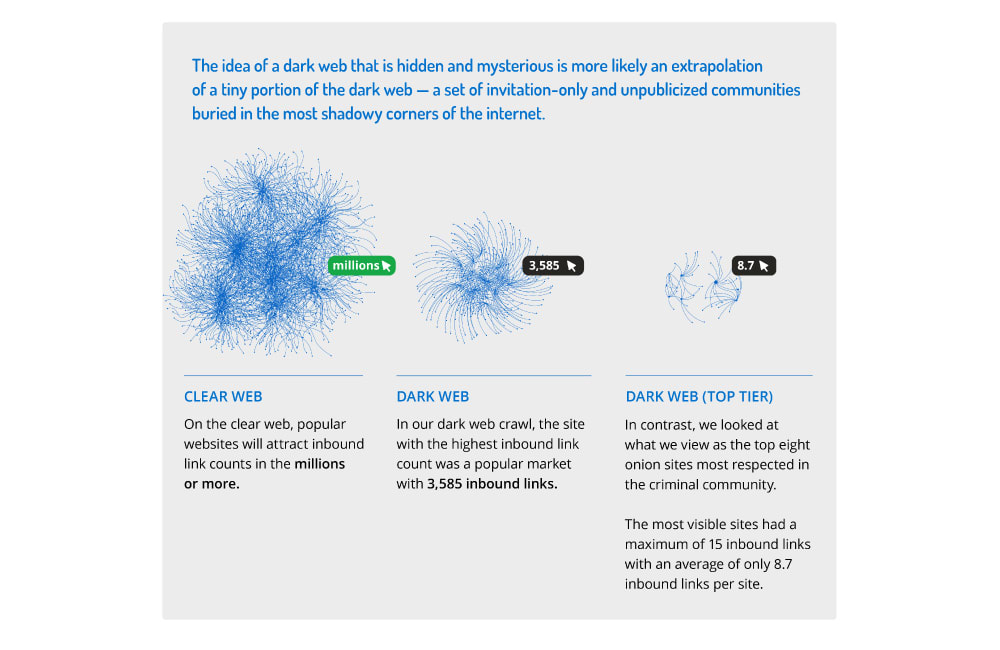
To estimate how inaccessible they are, researchers tried to determine how many inbound links point to these sites. They found that the most hidden sites have an average of 8.7 inbound links, while some of the most popular ones in the entire dark web they have several thousand. For comparison, the most popular surface web sites reach up to millions of links.
Here is an image that clearly illustrates the difference between the three types of domains:
In short, the Dark Web it is certainly not a place to navigate lightly, but perhaps we should start dismantling some enduring myths.