

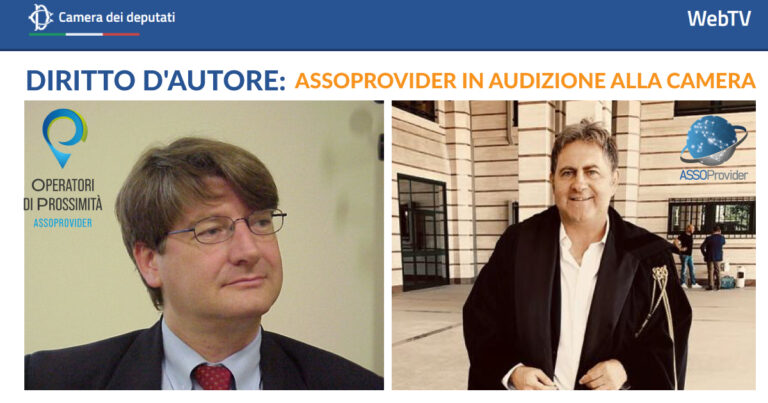
Bortolotto, president of Assoprovider, in a hearing at the Chamber on copyright protection: "For Small Operators, costs would be unsustainable"
Copyright, copyright, piracy: the phenomenon in Italy is mainly linked to football matches, watched on streaming sites that do not hold the rights (about 11 million Italians use them, Fapav/Ipsos data), while the use of illegal downloading of music, movies, and TV series decreases.
To counter the phenomenon, three bills have been presented in recent years (specifically, 1357 Butti, 2188 Capitanio e 2679 Zanella), which provide new provisions to prevent and suppress the dissemination of copyright-protected content via the Internet.
In the examination of these proposals, the joint Culture and Transport Committees of the Chamber heard the opinions of several trade associations: in addition to Assoprovider, heard as an association that gathers Proximity Operators (ISP and WISP), representatives from Aiip (Associazione Italiana Internet Provider), Fapav (Federazione per la Tutela dei Contenuti Audiovisivi e Multimediali), Siae, and Aie (Associazione italiana editori) participated.
For Assoprovider, President Dino Bortolotto and lawyer Fulvio Sarzana participated.
Bortolotto: "Unsustainable Costs for Operators"
The discussion essentially focuses on one point: do Internet Service Providers have responsibilities in combating piracy? Should they intervene directly and autonomously on those who access copyright-protected content?
In reality, as noted by the participants, Proximity Operators do not gain any advantage from piracy and, in fact, have everything to lose, suffering economic damage due to the increase in traffic volumes.
President Bortolotto then recalls that "the optimal point of intervention against piracy should be the origin and not the destination: essentially, action should be taken against those who "produce" and share illegal content, not against the users who consume it.
For this reason, TLC Operators cannot be consulted, since "I am the last link in the transmission chain, the subject furthest from the one committing the crime..
In technical terms, an ISP should intervene with a negazione del servizio applied to the destination on an illicit origin. For Bortolotto, this possibility "it is entirely to be verified in constitutional terms: there is indeed the risk that a private entity may decide in total autonomy which IP address should be obscured, without the intervention of the judicial authority.
Not only that: what would happen if, due to a clerical error, an incorrect IP address were indicated?
The president of Assoprovider provides an example:
«Let's imagine what could happen if the IP address used to control the Mose of Venice were mistakenly blocked: the consequences would be catastrophic».
Bortolotto also recalls the potential economic consequences of such an intervention by the ISPs:
«For the small operators we represent, such costs can make a difference: our members cannot "spread" this amount over millions of users, as large telecommunications operators could. This would undermine the economic and business rights of ISPs, guaranteed by the Constitution.».
In conclusion, it explains that Assoprovider is always willing to “always and in any case comply with the law, but also that “will use all available tools to counter decisions that could pose an obstacle to the entrepreneurial freedom of the members.
Review the complete speeches by Dino Bortolotto and Fulvio Sarzana, starting from minute 21:
Sarzana: "There is a risk of violating EU regulations"
Following Bortolotto's speech, the reflection of Fulvio Sarzana, lawyer and legal consultant of Assoprovider, follows. Sarzana focuses on the potential conflicts that the new regulations might create with EU law:
«The formulation of the draft laws is unusual: if approved, these regulations could violate several EU provisions, such as those in force on electronic commerce, which prohibit prior control by operators over what happens on the Internet.».
Criminal law also provides that "only the judicial authority can impose certain obligations and requirements”, recalls the legal advisor.
Sarzana also insists on the issue of costs:
«We know that most copyright infringement operations occur abroad: the new regulations would require Italian entities, at very high costs, to intervene to block access to foreign sites by Italian citizens.».It is therefore unacceptable that such “enforcement be introduced at the national level, derogating from the community discipline: I therefore invite you to reconsider the legislative proposals, to better specify them and verify their compatibility with European regulations”, concludes Sarzana.