


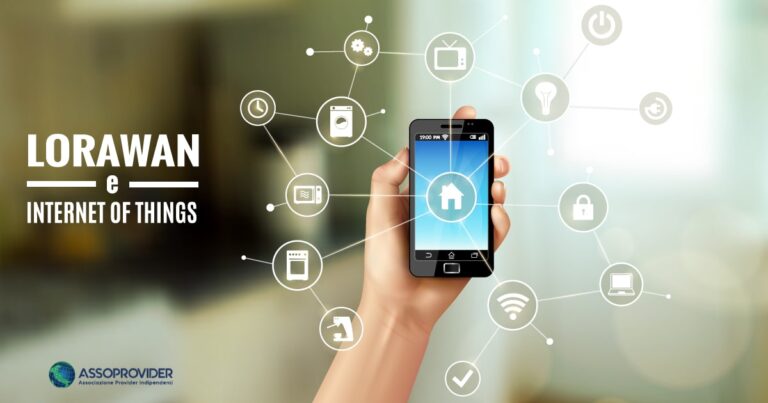
Cos’è LoRaWAN, perché se ne parla tanto e come può diventare una grande opportunità per tutti i provider indipendenti? Per rispondere a queste domande, e a tante altre curiosità, intervistiamo Marco Caldarazzo, CEO of Metrowimax, and responsible for Assoprovider of the project LoRaWAN. Marco helps the association members to learn more about technology and to promote its experimentation:
"This technology is revolutionary because it allows small operators to compete with the big players in telecommunications on equal footing, focusing entirely on the creation of personalized and innovative services.", explains Marco.
What is LoRaWAN
LoRaWAN è, innanzitutto, una rete di telecomunicazione wireless, progettata per favorire la comunicazione tra dispositivi elettronici. Si tratta di un LPWAN, acronimo che sta per Low Power Wide Area Network. Grazie alle sue caratteristiche è considerata la rete ideale per supportare le tecnologie nell’ambito dell’Internet delle Cose:
"The technology has existed for several years to connect machines in the industrial sector. Its turning point coincides with the spread of technologies related to the Internet of Things sector, which is set to grow: according to experts' estimates, there will be 80 billion connected objects by 2025. What is needed is a nationwide network, a task we intend to accomplish with the collaboration of the companies in Assoprovider."
From a technical standpoint, LoRaWAN is based on LoRa (long range) technology, which was created by Semtech, with an open development model: anyone can build networks, devices, and vertical services on the protocol. The Lora Alliance foundation is a non-profit organization established to promote the global spread of LoRaWAN. as we narrate here.
The opportunities and advantages of LoRaWAN
LoRaWAN is a highly flexible technology that can be applied in various fields: from smart cities, to industry, agriculture, and even logistics. Furthermore, it is accessible to everyone: it has low implementation costs, relatively low consumption, and can support large networks with millions of devices.
"Today, for a small or medium telecom operator, competing with the big players in areas like connectivity is becoming increasingly complex. LoRaWan, on the other hand, would allow smaller operators to enter the market on equal footing with the larger ones, increasingly focusing on quality services, both for private individuals and businesses."
Marco envisions a future scenario where a nationwide LoRaWAN network will be established, thanks to a synergistic effort among independent providers:
"A national coverage would allow a Sicilian operator to sell verticalized services to companies in Valle D'Aosta and vice versa. The example of the Netherlands, a leading country in LoRaWAN, teaches us this. In the Netherlands, there is a confederated network that allows providers to make direct agreements with companies engaged in the IoT sector. Assoprovider's idea is to create a similar network to share best practices and services."
An unexplored market (but watch out for bureaucracy)
Marco reveals another advantage for companies that decide to experiment with technology today: the absence of major players in Europe.
"Compared to mobile, where investments are substantial to compete, with LoRaWAN a gateway can cost in the order of thousands of euros. While it is true that Semtech is one of the leading companies, the real unexplored market is on the application front, where there is not yet a dominant player. Therefore, the space and opportunities are open to everyone."
A statement that clashes with a regulatory framework in Italy that is still not very accommodating, on which Assoprovider and its legal experts are trying to shed light.
According to Italian laws, the frequencies (863-870 MHz) are managed by the Ministry of Defense for primarily military and national defense purposes and cannot be used for the creation of public networks, while experiments for private use are possible.
This despite – as noted by lawyer Vincenzo Gallotto – an implementing decision by the European Commission (2018/1538) of 11 October 2018.
This decision calls for the harmonization of the radio spectrum for future use, among others,of systems ‘Internet of Things’ in the bands 874-876 MHz and 915-921 MHz. While in any case leaving unaffected the ability of individual European states to discretionarily reserve part of the same frequencies for the maintenance of military and security uses therein.
While awaiting a more favorable regulatory framework, anyone wishing to use the frequency for experiments can fill out a request form, with a processing fee of 250 euros, the submission of a summary test plan related to their activities, and other documentation, directly to the institutional emails of MISE. For further technical information, you can write to segreteria@assoprovider.it.
Assoprovider's commitments for LoRaWAN
Marco leads a team of pioneers at Assoprovider who have been experimenting with the technology and its potential for several months. Assoprovider offers its members multiple meetings per month (including courses, webinars, and even physical meetings at the Campania headquarters, which will resume after the emergency) to provide useful advice to other providers who wish to approach the technology:
"We are working on multiple fronts. The legal front with our lawyers, the training front, and then on creating partnerships at the European level. As an association, we have already requested to become part of Lora Alliance."
In addition to inviting all those interested in LoRaWAN to join the association, Marco offers some advice to start understanding more about the technology:
First of all, participate in online communities, such as the largest https://www.thethingsnetwork.org/, which is somewhat of an "Intergalactic Guide to LoRaWAN." And then study some successful international cases to find the right inspiration. Like the many incredible solutions born thanks to the technology, such as Gap that supports the monitoring of endangered species, such as the elephants of the Tropical Forest, and Beep which operates to enable "smart" management of beehives", concludes Marco.