

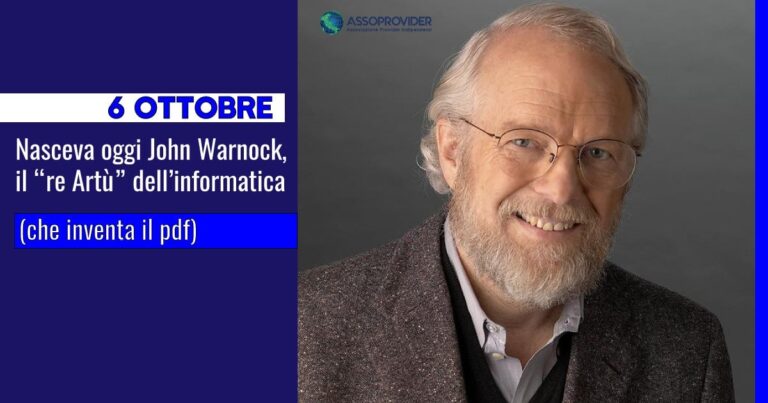
Today, October 6, is the birthday of John E. Warnock, mathematician "by mistake", programmer, co-founder of Adobe, inventor of PDF and some of the most widely used software in the world.
Let's discover the story of this pioneer and why he can be considered the "King Arthur" of computing.
From hatred for mathematics to programming
When does he/she go to school? as a child hate mathematics. He is repeatedly rejected and engineering is the last path he/she/they consider(s) to take. When enrolling at the University, he does it only because all his peers do it. Here, however, meet a teacher who changes everything and makes him passionate about numbers.
To support himself at the University of Utah, he works for a tire retailer in the meantime. In the morning, he studies mathematics – during the master's program, performs feats such as solving the Jacobson radical, an algebraic problem that had remained unsolved until then – repairs car tires during the day.
Having completed his studies, he is unsure which path to take. He would like to teach, but he knows the pay is not excellent. So, send his resume to IBM, which is looking for newly graduated mathematicians. He starts an internship, during which he learns programming.
Il prossimo impiego è con Evans & Sutherland, a computer graphics company in the Bay Area, California, where he begins working on creating a programming language that allows printers to communicate with computers: a passion that will stay with him in the years to come, as we will see.
When the company proposes that he return to Salt Lake City, his hometown, he decides to decline: he and his wife do not want to return to Utah. He discovers, through a friend, that at Xerox PARC [Palo Alto Research Center] a certain Chuck Geschke, former mathematics teacher, is launching the Imaging Science Laboratory, to create a personal computer and the first versions of a graphical interface for PCs.
Warnock and Geschke thus meet at a job interview: it is the meeting that will change both their livesWarnock's first job at Xerox is the creation of software for graphical data representation.
The two will then begin working on an innovative protocol, which allows for the "translation" of complex images and shapes. A solution that enables faithful reproductions in high quality. It is a significant step forward for the time, when printers can only work on dots and lines.
It is InterPress, a tool that the two collaborators would like to launch on the market. However, Xerox, of which they are still employees, is holding back: the company wants to keep the protocol for itself, using it only on its own machines.
Adobe is founded
«The world would never have known our idea – tell Warnock – It immediately seemed like a crazy thing. We were two employees and we were building extraordinary things. And people wouldn't have been able to use them, enjoy the benefits. Adobe was born precisely from a feeling of frustration.».
Together with Geschke, he decided to leave Xerox and founded Adobe Systems in 1982, continuing to work on improving communication between PCs and printing devices. The first result of this work is PostScript. The software works as follows: the human operator can easily input directives for the printer, allowing it to reproduce lines, dots, letters, and images. Essentially, PostScript enables any computer to print images and documents. It is a revolution that allows the democratization of printer usage, until that moment the prerogative of a few large IT multinationals.
The software becomes the industry standard within a few years and even today many printers use an updated version of it.
Adobe does not stop at this success.We must diversify, explains Warnock to his partner. They then take some collaborators, who until that moment have worked on PostScript, and put them to work on new software for creating vector illustrations: It is 1987, Illustrator is born.
Two years later, brothers John and Thomas Knoll they propose to Adobe a revolutionary graphics program: it is Photoshop. Warnock and Geschke's company has been offering it under license since then.
The first Adobe products lead to exponential growth for the company. In 1990, eight years after its founding, revenues reached 170 million dollars, with profits amounting to 40 million.
Camelot Project arrives, the PDF
One of the reasons why Warnock and Geschke decide to also focus on other products is that PostScript has its limitations. In its early years, it operates on about a hundred printers in circulation. This is because the protocol “requires very powerful machines and printers”, as stated by Warnock himself:
«It is a long-term solution because the power of devices will grow over time, but today PostScrip is not usable on many of the machines on the market.».
The founder of Adobe wrote these words in a document from 1991, the “Camelot Project, named after the legendary castle where King Arthur resided in the world-famous mythological epic.
The document, consisting of six pages, anticipates the creation of a new file format, the PDF (Portable Document Format), which we all know today.
It is yet another revolution signed by Adobe. The format can indeed be used cross-platform: unlike PostScript, therefore, it does not require specific machine characteristics, but can be employed on any device, without differences. PDF documents, that is, they have an identical format on every computer: no more formatting issues when moving from one machine to another.
It is also free of charge and the information transferred with the new format (whether text or images) is in no way lost or damaged. Features that transform it in a short time into a standard, used by millions of people worldwide for document publishing.
Today, software is ubiquitous: in 2018, according to Adobe data, 250 billion PDFs have been opened worldwide.
Adobe today
The beginnings of Adobe's history were not easy. When Warnock and Geschke present their first invention, many people do not understand its usefulness. When will it be presented to Gartner Group?, one of the managers tells him: ""This is the stupidest idea I've ever heard in my life".
But in the end, they will be right. Over the years, Adobe has developed numerous solutions, now used on computers, smartphones, and tablets worldwide, both by individuals and businesses. A recent example is Adobe Scan, an app for iOS and Android that allows document scanning even from mobile: it has been downloaded more than 35 million times. And then there are digital signatures, cloud service offerings, data analysis.
Adobe does not seem capable of stopping its growth. Today it is under the leadership of Shantanu Narayen, CEO since 2007, and continues to generate numbers: the revenues have passed from 4.7 billion dollars in 2015 to 9 billion in 2018, in a continuous crescendo. The company's employees today number more than 22,000.
Tutto è nato dall’ambizione e la voglia di rivoluzionare il mondo dell’informatica di due giovani matematici. Il segreto del successo? Eccolo, secondo John Warnock:
"I have never focused on my limits, or those of a project. When you think like that, you end up being cautious and not getting very far."