


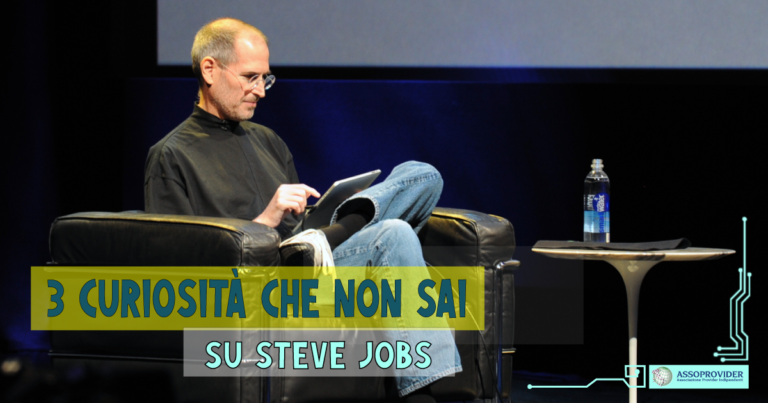
Today, February 24, is the birthday of the genius who invented Apple and revolutionized everyone's life with the smartphone: Steve Jobs.
If today four billion people are online (about half of the world's population), it is also thanks to him. The smartphone, launched in 2007 by Apple's charismatic leader, has given the opportunity to many who do not have a PC to access the Internet. Pmore than 75% of the world's population owns a mobile phone and over half of these are smartphones (data Digital Report, We are Social, Hootsuite).
Rivers of ink have been written about the genius of Steve Jobs, but there is still much to say, as is always the case with figures who have made history. Here are three curiosities about him that you probably don't know yet.
He also patented glass stairs
How many things did Jobs invent? Everyone associates his name with iPhone, iPad, iPod, or the MacBook. Yet there are 323 patents that he filed in his lifetime: from packaging to adapters to the glass staircases found in many Apple Stores.
In this New York Times archive, all its patents are listed
The large number of patents, all for Apple, further highlights the specific weight that Jobs held within the company. on the creativity front. To make a comparison with other web giants, only 9 patents at Microsoft bear the name of the founder, Bill Gates. Meanwhile, there are just a dozen Google patents signed by the two founders, Larry Page and Sergey Brin.
He could have been the CEO of Google
Today, Google and Apple are competitors in various fields, especially in telecommunications, with Android and iOS vying for the title of the most popular mobile operating systems. Yet, history could have been very different. In Steven Levy's book, "In The Plex: How Google Thinks, Works and Shapes Our Lives," a story is told that could have changed the course of technology history.
Sergey Brin and Larry Page, the two founders of the famous search engine, wanted Jobs to be the CEO of their company, when it was still in the startup phase. Jobs declined the offer but offered to mentor the two, who were young entrepreneurs at the time. The story ends badly: when Google decided to enter the phone business, Jobs felt betrayed, to the point of threatening to take them to court if they copied features from his iPhone.
Steve Jobs owes much to an unknown person
When telling the story of Apple, reference is made to Jobs' garage, to his friend Steve Wozniak, while little, or almost nothing, is said about Paul Terrell.
A highly skilled and visionary entrepreneur, he was among the first in the United States to open a retail computer store.. A true pioneer of the Network.
His role in Apple's history was decisive: theits chain, Byte Shop, was the first to offer the Apple I, at the cost of 666,66$.
Terrell ordered about fifty units, helping Jobs and Wozniak secure funds to improve the prototype. The first order then attracted the attention of the first business angels, such as Mike Marulla, another decisive figure in the company's history: the then IBM electronic engineer was also a great pioneer, betting $250,000 on the newly founded Apple Computer in 1977.
Did you enjoy this story?
Read also —>>>> https://assoprovider.it/chi-ha-inventato-internet/