




European Electronic Communications Code: how authorization procedures for the installation of electronic communication infrastructures are changing. The Assoprovider webinar.
Assoprovider webinars return after the summer break. Engineer Alfredo Pasini, the association's regulatory consultant, will hold a live broadcast on the topic "Ultra-Broadband: Simplification of Authorization Procedures for the Installation of Electronic Communication Infrastructures."
During the event, moderated by Vice President Marcello Cama, the regulatory simplifications related to the approval of the European Electronic Communications Code, transposed with Legislative Decree 207/2021, are illustrated.
We present a summary of the main contents. You can review the live broadcast on Assoprovider's official YouTube channel:
Installation of electronic communication infrastructures
The main innovation concerns the fact that public communication network infrastructures and infrastructural networks for ultra-broadband fiber optic networks are comparable to works of primary urbanization. They therefore have the nature of public utility (they are on the same level as, for example, water or electrical systems). For this reason, they can therefore be located in any part of the municipal territory. If there are local regulations to identify specific areas for installation, these must not hinder their establishment and operation.
In essence, for the laying of optical fiber the building and urban planning regulations do not apply, except for the regulations protecting environmental and cultural assets, as well as those on protection from exposure to electric, magnetic, and electromagnetic fields (often a cause of delay)
The competent authorities make their own decisions regarding granting operators the right to install infrastructures. within 90 days on public or private properties.
Civil works, excavations, and public land occupation
Let's now move on to the simplified procedures for the installation of electronic communication infrastructures that involve the construction of civil works, excavations, or the occupation of public land.
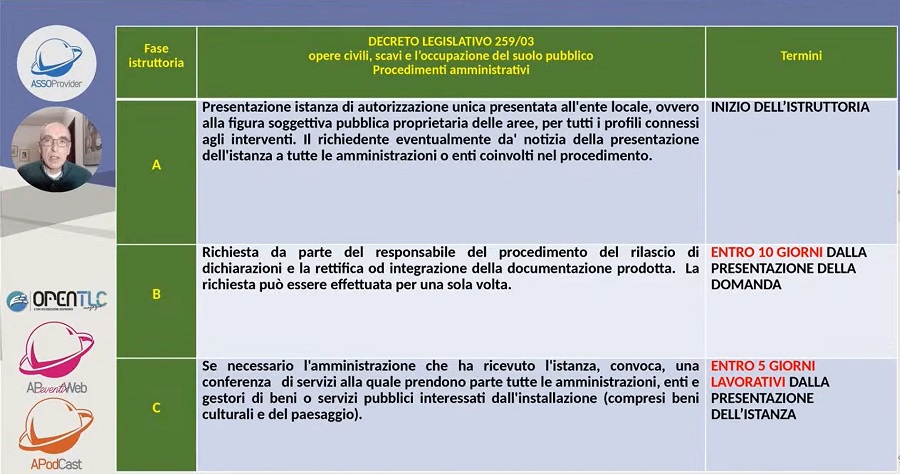
In this case, the operator must request an authorization to the managing body of the public place (generally the municipality or the province, depending on the jurisdiction), at the single desk of the entity. The application is unique and is made for all profiles related to the interventions.
If multiple entities are involved, one should contact the municipality with the largest population, which must convene, within 5 days working days, a conference of services to proceed with the approval.
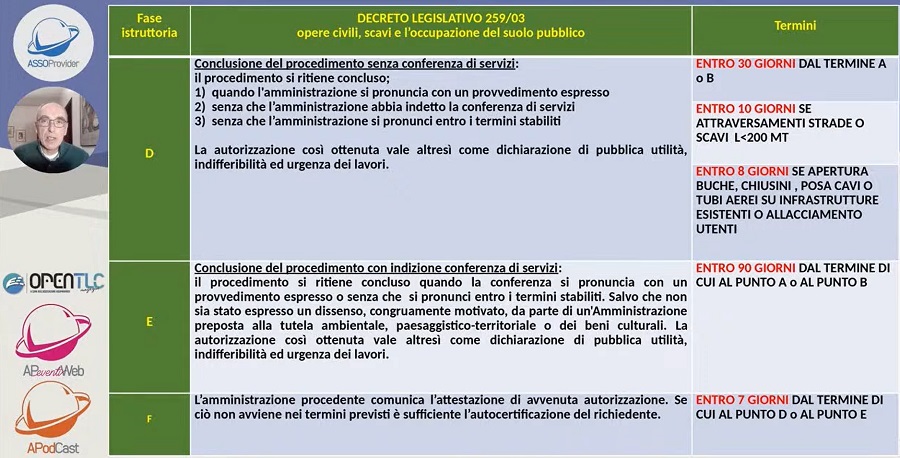
In the following two tables, we reconstruct the process of the preliminary phase to request authorization from the competent local authority:
During the webinar, engineer Pasini also focuses on possible changes during the work and the transit of cables through other properties.
Among the topics of greatest interest, the so-called SINFI, the Federated National Information System of Infrastructuresand a sort of national map of various types of infrastructure, not only regarding electronic communication.
If the installation of the infrastructures involves excavations, the operator is required to communicate the project in electronic format to SINFI, because in this way the interested administration can verify if in that area it is possible to share works, pipelines, and other infrastructures that may also serve other operators.
Within 30 days, they can then agree on a common plan for excavations and works.
To which types of charges and fees do operators face for the installation of networks or the provision of electronic communication services by PAs, regions, provinces, and municipalities?
No one, except for the patrimonial fee for concession, authorization, or advertising display (pursuant to art. 1 law 160/2019).
Installation of infrastructures for radioelectric systems
Article 44 of the regulation provides a series of measures for the installation of infrastructures for radioelectric systems, such as:
- Towers
- Towers
- Radio-transmitting system
- Electronic communication service repeaters
- Base radio stations for mobile electronic communications networks (GSM/UMTS/5G)
- Networks for broadcasting, distribution, and contribution dedicated to digital terrestrial television
- Radio frequency networks dedicated to health emergencies and civil protection
- Point-to-multipoint broadband radio networks
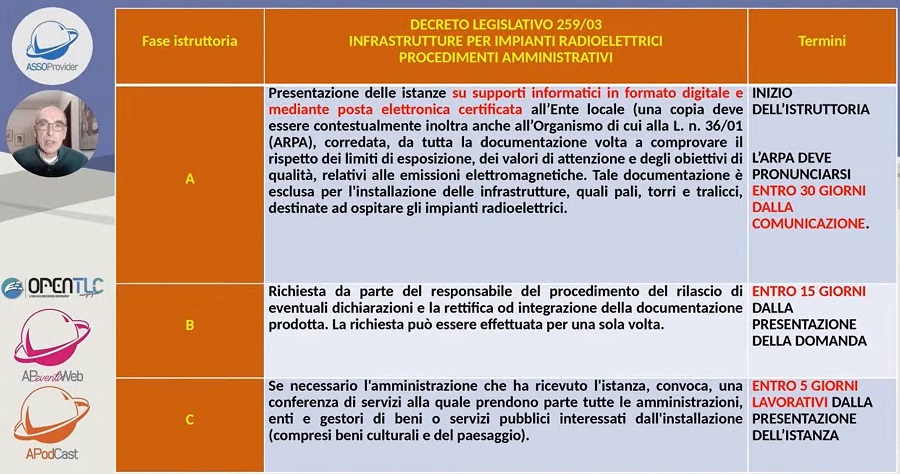
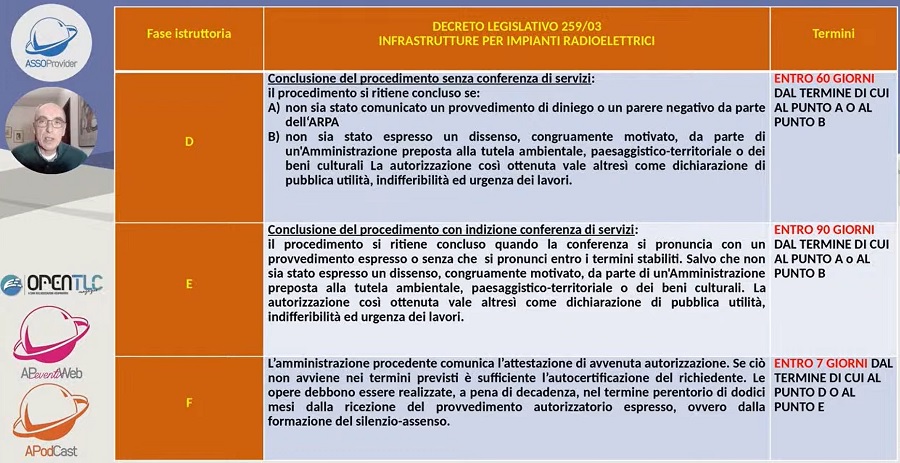
Also in this case, the issuance of an authorization by local authorities, after the verification of the competent ARPA on the compatibility of the project with the exposure limits (law no.36/01).
As previously, let's delve into the authorization process with summary tables:
The focus then shifts to the derogations provided for the infrastructure of radioelectric installations:
- For installations with power in a single antenna equal to or less than 20W is the certified notification of commencement of activity (SCIA).
- For installation of equipment for 4G technology, its evolutions or other technologies on infrastructures for pre-existing radioelectric installations, or modification of transmission characteristics, the interested party transmits in digital format, via PEC, the dimensional description of the plant to the Local Authority (and to ARPA in copy).
- The installations and modifications of radioelectric systems for point-to-point and point-to-multipoint transmission and radioelectric installations for access to public communication networks are subject to self-certification, if they have a maximum power in a single antenna less than or equal to 10W and with a radiant surface area not exceeding 0.5 square meters.
- The installation and activation of network devices characterized by a maximum transmitted power in uplink less than or equal to 100 mW, and with a maximum power at the antenna connector, in downlink, less than or equal to 5 W, and having a physical volume not exceeding 20 liters, may be carried out without any communication.
Further exemptions are provided for the so-called interventions of minor relevance or without relevance (microcells, indoor and tunnel coverage systems, etc.) and for the installation of temporary mobile telephony systems to be activated in case of emergency, for security reasons, during events or seasonal needs.
Digital infrastructure of buildings
The final topic of the webinar, law number 164 of 2014, which provided a series of regulations for regulate the digital infrastructure of buildings.
Among the key points:
- For newly constructed buildings or those undergoing major renovation, it is planned the mandatory requirement for equipping with multiservice physical infrastructure internal passive within the building, including communication systems high-speed fiber optic.
- Similarly, such buildings must be equipped with a access point: what is it about? It is a physical point, located inside or outside the building, accessible to authorized companies, which allows connection to the infrastructure prepared for ultra-broadband fiber optic access services.
- Buildings that exhibit the characteristics mentioned above can benefit from the label "building equipped for broadband". This certification becomes mandatory for constructions for which the application for building certification was submitted after January 1, 2022.
To stay updated on current regulations and make your voice heard at institutional tables, join Assoprovider, the association of Proximity Operators.
With us you can:
- Access the newsletter dedicated to AP-Normativa regulations
- Participate in online and offline events to keep up with compliance
- Request information from our reference experts