



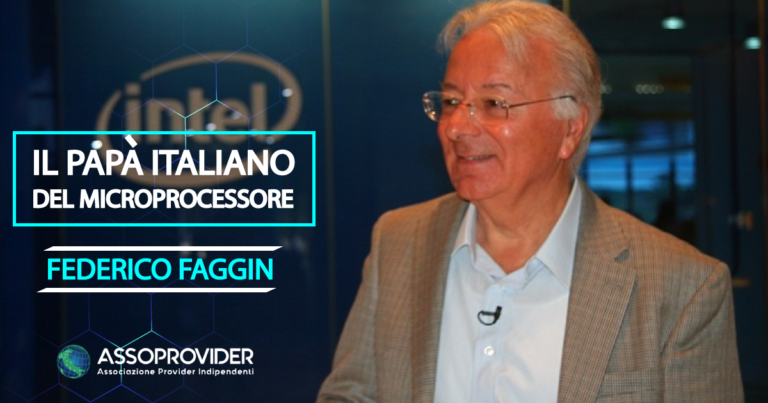
"Before Faggin, the Silicon Valley it was simply the Valley," is a phrase with which Bill Gates paid tribute to Federico Faggin, Italian genius, the father of the microprocessor. We tell his story today as Faggin celebrates his 79th birthdayHis life is a great adventure, from fleeing Italy, to his insight in Silicon Valley with the invention of the microprocessor, to his clashes with the head of Intel, up to the second youth spent creating successful startups, anticipating technologies that would change the world, like the touchscreen.
The realization of the American dream
His passion for inventions has distinguished his life since a very young age, when in Isola Vicentina, where he was born and raised, he built his first model airplane. With a diploma as a radio technician in hand, he is already recognized as a young talent, so much so that Olivetti decides to hire him. However, he is not yet fully satisfied with his knowledge and has the courage to leave a good job to return to studying. He enrolls in the Faculty of Physics and in less than 4 years, he graduates with honors, achieving a score of 110 cum laude.
The event that would change his life forever is near. Hired by a company in Brianza, Sgs, he is sent to America to gain experience at the Fairchild Semiconductor of Palo Alto, with which the Brianza company was associated. Once he set foot in California, he would never return to Italy.
The curse of Grove (former Intel CEO): "If you leave, you will be erased from history"
The first major opportunity is Intel, the giant in computing from Mountain View recognizes his genius and hires him. And rightly so. Once at Intel, Faggin is put in charge of a team working on the development of a new type of processor. Thanks to his talent, he designs two: Intel 4004, which goes down in history as the world's first microprocessor, and then Intel 8080, the second-generation microprocessor. The microprocessor becomes the brain inside computers, mobile phones, cars, cameras, even TVs and refrigerators, and will forever mark Intel's success in the market.
Despite these successes, the relationship between him and the then CEO of Intel, Andy Grove, they are very tense. When Faggin decides to leave the company, Grove casts a real curse on him: "If you leave here, you will be erased from history. You will fail in everything you do."
Grove indeed tries to put obstacles in Faggin's way and attributes his invention to another of his engineers, Ted Hoff. However, Faggin does not give up and begins a series of battles, which he eventually wins, to be recognized as the inventor.
The second life as a serial startupper and that meeting with Jobs
Once he left Intel, he founded one startup after another. Zilog it is the first, with which it invents the third-generation microprocessor. Then again Cygnet Technologies. But it is with his third startup, Synaptics, once again becoming a pioneer by developing the first technological systems of touchpad and touchscreen in 1994.
With this technology in hand, he goes to Steve Jobs interested in his work. However, Jobs wanted exclusivity, but Faggin knew how to say no (tell the episode, this article from Sole24Ore). In his subsequent statements, however, Faggin has always praised Jobs for his ability to have intuited the potential of the technology and then committed himself to creating a market from scratch for its use, the smartphone.
Thanks to his work, Faggin would have received numerous accolades. He is the only Italian featured on the Walk of Fame of the Computer History Museum in Mountain View and obtained from the former American president, Barack Obama, the National Medal of Technology and Innovation. Recently joined the advisory board of Roboze, an Italian-Californian company specializing in the design and production of 3D printers
3 quotes by Faggin that we cannot forget
In his interview within the book, "Silicon Valley" (Eleonora Chioda and Tiziana Tripepi, Hoepli) Faggin offers some pearls of great wisdom that further explain his genius. We present them here.
"We all have the potential to understand situations intuitively. If we are afraid of making mistakes, we block intuition and take refuge in reason, which seems more solid and sound. Intuition is the typical ability of those who invent something."
"Today I turn my gaze within the human being. We human beings are much more than machines. During the 1980s, I began to study consciousness and to ask myself: is it possible to build a conscious computer?"
"If Italians go abroad and learn how to innovate and conduct research, when they return, they bring wealth and values that Italy does not yet possess."