


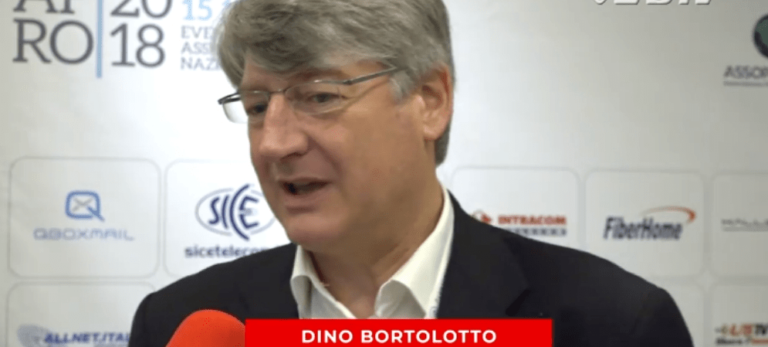
First day of the auction for 5G (September 13). Telecom, Fastweb, Vodafone, Wind... are the usual players trying to secure licenses for the "ether highways" until 2037: "Once again, the very old pattern of assigning a public asset to the usual monopolists is being repeated.". No one has wondered how to involve in this process the Internet Service Provider», report the president of Assoprovider, Dino Bortolotto.
In this interview, it explains Assoprovider's position on the topic and why the 5G auction is a "smokescreen" that "sweeps under the rug" the many forms of discrimination that characterize the telecommunications sector in Italy.
Why the topic of the auction for the 5G is it emblematic of a more important issue?
"For years, Europe has been telling us that the" exclusive frequency assignments must cease. And yet we find ourselves once again facing poor management of the electromagnetic spectrum in Italy, which is given in exclusive use to a few entities. Without involving other market players, such as Internet Service Providers. This replicates the scheme of other public concessions, vand the highway disaster in Genoa. When a collective asset falls into the hands of a few companies, it results in increasingly poor services for citizens.
Therefore, it makes little sense to discuss the allocation of 5G frequencies if there is no clarity in the sector?
"Exactly. The management of the electromagnetic spectrum in Italy has been flawed for 30 years, ever since attempts have been made to prioritize the interest of a private entity over that of the community. From the catastrophic allocation of broadcast frequencies for television use, then the management was born, ateven worse, of those point-to-point."
Bringing clarity to the assignment of point-to-point frequencies is one of the pillars of Assoprovider's program. Why are these frequencies of such interest to Internet Service Providers?
Point-to-point frequencies are used to interconnect the endpoints of the network. This is an asset with a high number of potential users. Unlike other frequencies, a point-to-point link can be used thousands of times by different entities. Currently, the economic management of these frequencies is scandalous. Internet Service Providers are the only ones who have to pay for its full use.. According to the current annex 10 of the communications code, if an ISP pays 100 annually as an administrative contribution, a telecommunications operator will pay 25 for the use of the same frequency, while a television operator will pay between 5 and 10.
In short, a real discrimination?
"Italy is the country that charges the most for point-to-point connections, twice as much as Poland, which is the most expensive among the European Community countries. If I go to England, the same service costs a tenth for comparison. Internet service providers are not only the most economically disadvantaged because they are the only ones who pay the full contribution, but they are also disadvantaged in terms of the frequency assignment procedure. Mobile operators, for example, can use a point-to-point frequency by making a subsequent declaration, without having to make any prior request to MISE.. On the contrary, all other operators must apply and wait for the assignment communication. Our category is disadvantaged because it does not have the power, like others, to have tailor-made laws enacted. For this reason, we argue that the 5G auction should be preceded by a thorough cleanup in the frequency sector."
In the end, are the most disadvantaged the citizens?
"Yes, and I'll explain it to you with an example. Given the current situation, c"as an Internet Service Provider, I have to pay for the use of a point-to-point frequency to deliver, for example, 100Mb/s approximately 5,000 euros the year. If I could pay 500, like the operator of a digital terrestrial TV, I could provide broadband at the same prices practiced in cities to a community composed of only 10 users who reside, perhaps, in an area where the digital divide is significant.. On the contrary, if I am forced to pay 5,000, there are no economic margins to do so, ».
How advantageous is it for the State to maintain such high prices?
"It is not advantageous for them at all; in fact, it harms their finances. From MISE data, we know that in Italy, more than 100,000 point-to-point frequencies are used out of a total number of potential uses that we have calculated to be around 10 million. In practice, we are using only 1% of those available. It is as if a hotelier had 100 rooms but decided to rent only one at a frightening cost, instead of many at a lower cost."
Many citizens are therefore without a digital connection also because the state maintains high administrative contributions for a territorial collective asset (the radio frequencies confined to that territory) essential for bridging the digital divide precisely in low-density areas that are often completely neglected by larger operators». .
What are Assoprovider's proposals for regulating the sector?
«We will engage in dialogue with the Ministry of Economic Development to make point-to-point data transparent. How much money do Telecom, Vodafone, and others pay to occupy them? Then we will reiterate our counterproposal, which already exists and is a very simple amendment: to equate the administrative contribution fee paid by Service Providers to that of television operators. We are not asking for special rates, but why should we be disadvantaged compared to others?».