


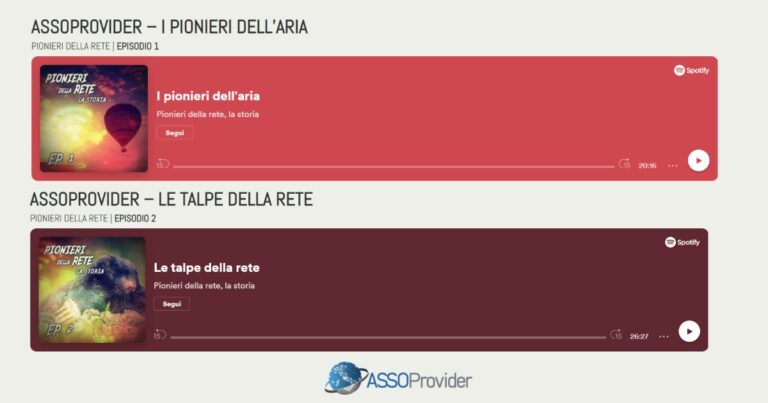
We tell the story of the Internet in Italy with two podcasts branded Assoprovider: listen to the voices of the Pioneers of the Network, both from the air and from the ground…
"Pionieri della Rete" is the new podcast by Assoprovider, which tells the story of Italian Internet Service Providers, true pioneers who, like those who ventured to conquer the West in the 19th century, explored the uncharted prairies of connectivity in Italy, especially in small towns. Acting as "proximity operators" for private individuals and public administrations, who needed new technologies and services but were plagued by a frightening digital divide compared to large cities: if today, even in the most remote corners of Italy, it is possible to connect to the Internet, we owe it to them. In the podcasts, we will hear their stories.
"Pioneers of the Network" is produced in collaboration with AVM, TP-Link, SICE-Telecom, Netresults and supported by Radio IT.
Today we will tell you about the first two episodes.
Pioneers of the air in small towns, with Wi-Fi and 5G
Behind seemingly simple operations like connecting a PC or a smartphone to a network, there is actually the work of many people who have enabled everyone to enjoy that extraordinary invention called the Internet.
In this first episode of Pionieri della Rete, we tell the story of those who made that gesture so commonplace. These are local operators, founders and/or members of Assoprovider with an innovative vision who, over 20 years ago, ventured to explore new technological territories. In the four stories of the first podcast "Pionieri della Rete," there is a single common thread that ties them together: it is the air, which allows us to connect through Wi-Fi and 5G.
The first story is that of Lorenzo Busatti, founding member of Assoprovider, electronic designer, who in 1997 moved from Florence to Grosseto to establish an Internet Service Provider in an area where few people still know what the Internet actually is. Two years later, Lorenzo will be among those he calls "crazy," the founders of Assoprovider, another essential milestone for the development of the Internet in Italy, in July 1999.
After the first few years of work, Lorenzo moved into the wireless world in 2006, conducting various experiments in the sector. It will be thanks to the Assoprovider's battles on the liberalization of wi-fi, that Lorenzo will finally be able to get his business off the ground. After some difficulties with renting transmission towers, Lorenzo then begins to build his own, acquiring the skills and means necessary to succeed.
In Torre del Greco (NA), even before Lorenzo, another pioneer, Marco Caldarazzo, an Assoprovider member, was active: towards the end of the 1980s, when the Internet as we know it today did not essentially exist, his company dealt with innovative networks for the time, namely Bulletin Board Systems (BBS), the first telematic systems capable of allowing remote computer connections to access shared files and send messages.
It was in 2000 that Caldarazzo discovered wi-fi technology, which was then unknown in Italy (he had to have the first equipment sent from the United States),which immediately fascinated me", he recounts. A job that will bring him many satisfactions, leading up to connecting the paddock to the Moto Class 125 world championships for the team of the unforgettable Marco Simoncelli, the "Sic".
Then there is the story of Paolo Di Francesco, national councilor of Assoprovider, with the first experiments in telecommunications already twenty years ago, in the field of university research.After a few years, we tried to bring the research to the market: a great challenge", he recounts. In 2005/2006, he then started the activity of an Internet Service Provider, especially in small local communities with fewer than 5,000 inhabitants, at risk of depopulation and afflicted by a significant Digital Divide.
In particular, in recent years, Paolo has initiated an innovation that combines 5G, small rural communities, and Virtual Reality in the small municipality of Buseto Palizzolo, in the province of Trapani, transforming it into a technological center of international significance: there is nothing similar, in fact, in Europe, except in large cities like London, Bristol, and Barcelona.
Innovation that, still within the context of Assoprovider, has also led to significant fruits of collaboration.
In fact, it was born in 2018, during the national event of Assoprovider, the partnership with Antonella Oliviero of Consulsat and national advisor of Assoprovider, the fourth narrator of this episode: born as a WISP in 2005, since 2016 Antonella has also gained experience in the television world, with the launch of a regional TV channel, LabTV.
Together with Paolo Di Francesco, they then join forces to launch Octopus, a project to combine 5G and television:
«We have developed – says Antonella – a program that allows, through the 5G connection, to receive real-time information about well-known personalities being interviewed on TV. This information is then projected on the screen thanks to Augmented Reality: think of the classic lower thirds, which contain the interviewee's name and appear on our TVs. Octopus is capable of compiling them automatically, reducing potential errors and facilitating the work of journalists and post-production staff.».
Listen now to the full first episode of the "Pionieri della Rete" podcast by clicking on the link: Pioneers of the Network Episode 1
The moles of the network: the pioneers of fiber optics
The second episode of "Pionieri della Rete" involves moles, animals known for their underground burrows, which dig into the ground: we will indeed talk about "fiber optics," that remarkable thing enclosed in cables which, in turn, are laid underground.
Here too, the biographies of our proximity operators are filled with adventurous anecdotes and cutting-edge technologies. To the point that some of them earn the challenging nickname of "evangelists" of the Network, as they have been able to spread new technologies in many excluded areas of our country.
The first story is that of Marco Liss, national councilor of Assoprovider: already at the end of 1995, with his company Nemo SRL, he began to bring free internet connection to schools and conducted basic computer training courses. Simply put, even using a mouse was a problem 25 years ago:It seems like prehistory, but at the time it wasn't like that., Marco recounts.
Even today, in schools, the company offers training projects dedicated to topics such as coding or cyberbullying, as is the case for a school in Seregno in Monza-Brianza: a project that Nemo presented in London, at Apple's headquarters, among the Best Practices in the field of education at the European level.
Focusing on relations with the Public Administration, Nemo has managed over the years to create a fiber optic infrastructure of about 60 km in Legnano (MI) alone, the city where the company primarily operates, and a total of 200 km in the region, using the innovative "nano-trench" system, which allows for very precise cuts in the road.
From Lombardy, we move down to Puglia, where Francesco Cucci, an Assoprovider member who founded Dodonet in Fasano, in the province of Bari. Until a few years ago, he was involved in Wi-Fi, before becoming another "mole" of the Network, even here, offering an innovative service that is not widely available in Italy.
Since 2019, Francesco has been implementing GPON (Gigabit Passive Optical Network) technology, passive fiber, which does not require devices powered by the street electrical network. The service has allowed Dodonet to "to project ourselves into the future, with a bandwidth far exceeding current needs”. Following the success of the technology in Fasano, Dodonet has also begun the cabling of Monopoli.
Further south, we discover WT IcaroInternet, established in the province of Messina in 2010, founded by Davide Gelardi, national councilor of Assoprovider. After five years of activity in Wi-Fi, the company began experimenting with fiber optics, also offering an innovative service here. This is FTTH "Fiber to the Home," which, unlike FTTC "Fiber to the Cabinet," brings fiber directly into the building rather than just to the street cabinet as in the case of FTTC. Essentially, with FTTC, the most widespread in Italy at the moment, the fiber reaches the cabinet at the end of the street and then enters the home only through the traditional telephone cable, the copper pair.
Davide lists the numerous aspects of FTTH technology,from service stability to higher speed. Above all, it is about “an enabling technology for the future: as the speed of the Network increases, it will be possible to benefit from it simply by changing only the modem in customers' homes, without having to replace the cables in the street..
FTTH is a service generally covered in large cities, while once again, the members of Assoprovider demonstrate their proximity operator attitude by bringing innovation even to less urbanized areas.
Listen now to the full second episode of the "Pionieri della Rete" podcast by clicking on the link: Pioneers of the Network Episode 2