


Another appointment with the history of one of the pioneers of the Internet. Today we recount the genius and life of Rasmus Lerdorf, through his deeds and memorable quotes.
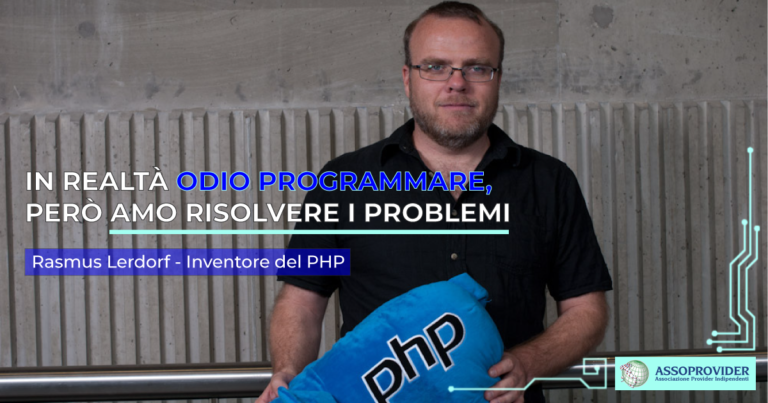
The inventor of PHP, one of the most revolutionary scripting codes on the web, is a man who loves to make statements that surprise: «"I don't love programming, but I love solving problems," is one of the most famous quotes from the pioneer of the Internet.».
Rasmus Lerdorf is one of the most sought-after tech figures by major companies. (today works at Etsy, a renowned e-commerce platform with millions of users worldwide).
The programming genius was born in Greenland in the late Seventies. A globetrotter by nature, he first moves to Canada, where he lives in Toronto and later in Ontario, graduating in Applied Sciences in System Design Engineering.
The American dream leads him to move to America, where he immediately stands out for his incredible programming skills. First IBM, then Yahoo! it is the multinationals that compete for the young Rasmus, and in which he will build his career: at Yahoo! he is appointed Infrastructure Architecture Engineer.
I am Rasmus and I solve problems
«I worked at Yahoo! for seven years, but I was extremely demoralized. I worked in a company that based its success on advertising, which developed strategies to force its users to watch advertisements», Rasmus stated in an interview.
His approach to the world of programming is very simple: "Solving problems." And he demonstrates this throughout his activity, particularly in the year 1994. During that period, the programmer faces a significant obstacle and finds the right path to overcome it:
«When the web exploded, companies were eager. They wanted to embrace its possibilities, and their first move was to publish all their documentation online. So what did they do? They asked their technicians to handle it. They used Microsoft Word, saved the documents as HTML, and uploaded them online via FTP.. All correct… until companies began to want these documents to be more dynamic», recalls Rasmus.
The programmer hits the heart of the time problem. A way was needed to create new, faster forms of interaction and not being forced to rewrite an entire web page just to add a few pieces of information like a phone number.
Rasmus has the solution to make web pages more dynamic: PHP, indeed.
1994: PHP is born
The first version of PHP is a collection of scripts that allow easier management of personal pages. Not surprisingly, PHP stands for Personal Home Page. Rasmus works on it over time and optimizes it.
The original package is rewritten in C, with the addition of some features. Fundamental to the success of the language is the possibility of integrating PHP code into HTML code. The integration allows the programmer to get straight to the point: simplifying the creation of dynamic PHP pages.
Language open source begins to circulate on the Internet: in a short time, 50,000 Internet domains adopt it, while a true community of developers who believe in Rasmus's project forms and supports it.
Among these, two young talents like Zeev Suraski and Andi Gutmans, who since 1998 have been assisting Rasmus in developing the third version of PHP. Together they rewrite the language engine, which is named Zend, from a contraction of their names.
PHP is enhanced with the contribution of the two programmers, areaching the point of competing with ASP, a language developed by Microsoft. Today it is at the seventh version. According to some statistics 82% of websites worldwide currently use PHP, including giants such as Facebook, Yahoo!, Mailchimp, Wikipedia, etc.
What is PHP in a nutshell
PHP is a lscripting language called server side because it resides on a remote server. During execution, PHP essentially does three things:
- Interpret the information received from a client through a web server
- Process the information
- Returns a result to the client who made the request
PHP can differentiate itself from other scripting languages. Differently, for example, from Java Script which is processed by the browser (for this reason, the same instruction works differently depending on the browser), PHP eliminates this risk because it is processed by an engine present on a web server.
The pros of PHP are essentially two, the ability to be deployed on any server machine, both Linux and Windows – is based on Apache – and the support of a large community of developers.
For more information, you can read the guide on html.it
Thoughts of a Pioneer in 3 Enlightening Statements
To those who ask if he will develop a new language
«I did not create PHP because I wanted to write a new language. But to solve a problem. What excites me is solving things. Programming bores me. SI am an engineer who loves using tools, and when there isn't one I need, I create it.. Today I have no need to create a new language».
On the functioning of PHP
«I have always thought of PHP as a practical solution to use like a toothbrush. You use it every day, it does its job, it's a simple tool. In the same way, I conceived PHP»..
On the brilliance of the programmer
«When I started writing PHP, I had no idea how to write a programming language. So what did I do? I proceeded step by step logically, adding a piece of the puzzle to another, along the way».
Would you like to read more stories of Internet Pioneers? You can find them all at the links below.