


All the innovations of the EU Directive 2018/1972, the new European Electronic Communications Code, which enhances the activities of independent providers, proximity operators.
«Il nuovo Codice Europeo valorizza gli “Operatori di Prossimità”, un nuovo concetto che Assoprovider ha introdotto per identificare i provider indipendenti, nasce leggendo l’Articolo 16 :
“Member States have the option not to apply administrative fees to companies whose turnover is below a certain threshold or whose activities do not reach a minimum market share or have a very limited territorial scope.
therefore, EU member countries are given the option to eliminate administrative fees on licensed frequencies for those operators willing to invest in "market failure" areas» : with these words from Marcello Cama, national vice president of Assoprovider, we understand the importance of the new European Electronic Communications Code.
The Code, Cama further explained at the beginning of a webinar dedicated to the European regulation, organized by Assoprovider with the contribution of AVM, SICE, and TP-Link, and directed by LabTV, becomes "our ABC” as a provider, a sort of "license to operate in the sector.
The Assoprovider advisor introduced the streaming event held on March 26, further explaining how today Assoprovider is "the most
large ICT network in Italy: we are in fact the largest and most widespread company of networking specialists. An entity that the Italian authorities will no longer be able to ignore, as has often happened, also because the new Code introduces many of the requests that Assoprovider has put forward over the years, such as the reduction of administrative fees on licensed frequencies.
Cama then introduced the keynote speaker of the event, engineer Alfredo Pasini, a freelancer and consultant for Telecommunications, Internet Service Providers, and Broadcasting companies, who detailed all the innovations of the European Electronic Communications Code.
Approval of the European Electronic Communications Code: where do we stand in Italy?
First of all, Engineer Pasini introduced the new Code from the perspective of its legislative path: the official name of the regulation is Directive (EU) 2018/1972, published in the Official Journal of the European Union in 2018, along with Regulation 2018/1971 which amends the framework of BEREC (Body of European Regulators for Electronic Communications), which is the European regulator of electronic communications, essentially the European AGCOM. As Pasini explains, BEREC is fundamental in the reform of the European Code because it implements it.
Following the European approval, Italy, like all member countries, is obliged to adopt it, thus modifying its national legislation in the matter, which is currently specified by legislative decree 259/03.
Italy is proceeding with a European delegation law, which includes various EU directives in addition to the Communications Code. This measure was approved by the Senate on October 29, 2020, and transmitted to the Chamber, where it is currently under review by the XIV EU Policies Commission in a Referent session.
As often happens, we are late: the new rules of the Code have been in effect throughout Europe since December 21, 2020, and Member States should have transposed the directive by that date. A Pre-Contentious procedure has therefore been initiated against Italy.
In any case, Italy is in "good" company regarding the delay: only Greece, Hungary, and Finland, among the EU members, have already transposed the directive.
The European Electronic Communications Code: the main innovations
In Article 1, the European Code immediately clarifies its main objectives, which are to create a "internal market for electronic communications networks and services", for the implementation and widespread dissemination of what are referred to as "ultra-high capacity networks", another key definition of the Directive, which essentially replaces the concepts of Broadband and Ultra Broadband.
Very High Capacity Networks) VHCN, from English Very High Capacity Network) is entrusted to BEREC, which thus becomes, as mentioned, fundamental in the context of the new Code. According to this new definition, all European households, including those in rural areas, must be able to browse with a connectivity of at least 100 Mb/s by 2025: a speed that can be achieved through fiber optic elements, but also with fixed and wireless networks, as long as they allow the same speed, in line with the principle of technological neutrality.
This, therefore, is the fundamental objective of the Code, which is achieved, as we read further in Article 1, through "sustainable competition, interoperability of electronic communication services, accessibility, network and service security, and benefits for end users". The Directive also stipulates that all consumers and end users (another important distinction introduced by the Code and clearly emphasized by engineer Pasini) be guaranteed "the provision […] of services of good quality publicly accessible and at affordable prices, through a effective competition and an actual possibility of choice, with particular attention to end users with disabilities.
Among other innovations introduced by the Code:
- Greater protection reserved for consumers, especially to simplify the transition between service providers;
- Introduction into the regulations, for the first time, of a clear definition of interpersonal communication services (consider WhatsApp);
- Establishment of a public alert system to send citizens, via mobile phone numbers, warnings in case of natural disasters or other serious emergencies;
- Creation of predictable regulation by Member States for operators to grant the use of radio spectrum for wireless broadband for at least 20 years: the aim here is to promote investments, especially in the crucial area of 5G connectivity.
- Introduction of new frequency bands for 5G connectivity for faster internet connections and improved connectivity;
- Encouragement of competition, with new regulations on operators' access to networks: it must become easier for operators to invest in new very high-capacity infrastructures, even in remote areas;
- New regulations on general authorization for companies providing electronic communication networks and services;
- Introduction of the obligation of “Contract summary", or the presentation to the consumer of a document that summarizes the necessary information contained in the electronic communication services supply contract.
You can review the full replay of the webinar by registering at this link:
Administrative Contributions: the battle of Assoprovider
The new European Code introduces, as mentioned, some fundamental innovations in the field of administrative contributions for licensed frequencies, a point on which Assoprovider has launched its latest battles.
Today, in fact, Italian regulations stipulate that the cost of licensed frequencies reaches as much as 7,000 euros per year: an unsustainable cost for an independent provider, which often provides connection and services to only ten users. For comparison, France requires a contribution of about 700 euros annually. A system made even more inequitable by the fact that large operators in the sector can enjoy a "quantity discount" of about 75 percent, to the detriment of small providers.
Engineer Pasini explains how the EU Directive 2018/1972 essentially supports Assoprovider's requests. It indeed stipulates that administrative contributions should "cover the only administrative costs incurred for management, the control and enforcement of the general authorization system, rights of use, and specific obligations”. Essentially, the contributions requested from operators cannot exceed the administrative costs actually incurred by the authorities: a disruptive regulation for the system as it is currently conceived in Italy.
Not only that. The Code also stipulates that contributions are imposed in a "transparent, objective, and proportionate”, effectively making it impossible to favor large operators.
The Directive finally grants the faculty, unfortunately not the obligation, to do not apply such administrative contributions to small providers, that is, operators who do not exceed a certain revenue threshold or do not reach a certain market share, or who have limited territorial reach. Essentially, the Directive, at least in its inspiration, favors the activities of proximity operators, which today in Italy – especially after the advent of the pandemic – help reduce the Digital Divide.
On Assoprovider's battle regarding administrative contributions, also read: [APodcast] Assoprovider and the battle of the small against the big (and the law of the strongest)
European Electronic Communications Code: the second meeting with Assoprovider
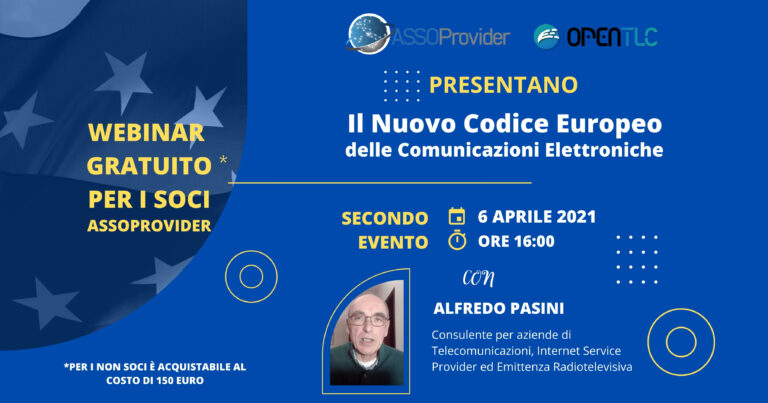
As we have seen, the European Code introduces many important innovations for the electronic communications market in Italy and, therefore, for all operators in the sector. This is why Assoprovider has scheduled a second webinar on the subject, again with the contribution of engineer Pasini, which this time will focus in detail on:
- Radiolan radio spectrum;
- Geographical mapping of network installations;
- Investments in ultra-high capacity networks;
- Cybersecurity.
Appointment on April 6, 2021, at 4:00 PM. The webinar is free for Assoprovider members only, while a participation fee is required for all other interested parties.
More information and registration at the link: https://opentlc.it/1eventiwww