


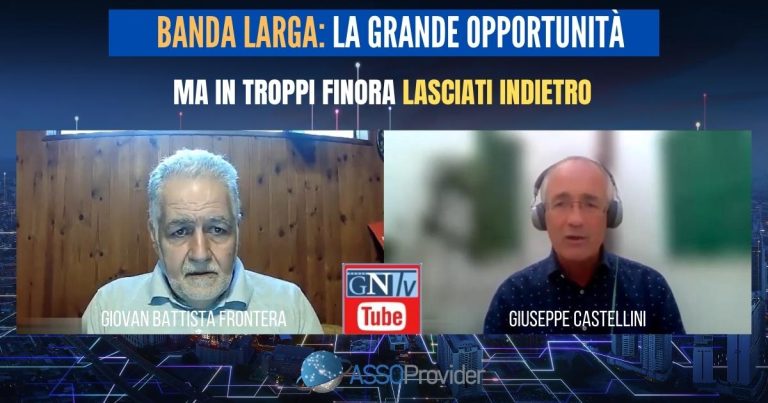
Interview with the Vice President of Assoprovider on the state of the art of the digital divide, both technological and cognitive, in Italy and on the role of Proximity Operators in digital development.
The installation of fiber for centralized Ultrabroadband shows its limitations. It is time to move to a decentralized management, featuring Proximity Operators alongside local administrations: a path we have already embarked on for several years, as demonstrated by the experience in Umbria (unfortunately failed) and other initiatives.
These are the points addressed by Giovanbattista Frontera, National Vice President of Assoprovider, in a video interview with the Nuovo Giornale Nazionale conducted by Giuseppe Castellini.
The role of Proximity Operators against the Digital Divide (including cognitive)
As demonstrated by a recent investigation by key4biz, at this rate, the White Areas will be cabled by Open Fiber only in 8 years, if we continue at this pace (approximately 50,000 housing units reached by June 2022 compared to the 6.3 million that should be cabled by next year).
"The solution to the problem is still far off. Either we start from a decentralized logic, otherwise it is difficult to make much progress: there are more financial than operational logics in the current management," explains Frontera during the interview. He then proposes an alternative path, already underway, which primarily involves Proximity Operators.
"Our members," says the vice president of Assoprovider, "have already started laying their own fiber, especially in market failure areas, where the arrival of the Big players, including Open Fiber, is still yet to come."
However, the role of Operators in overcoming the Digital Divide is not limited to this. Frontera indeed recalls that there is a structural Divide, due to technological transfer, but also a cognitive one, caused by the scarcity of skills.
To address the issue, Assoprovider "has published a guide for municipalities to implement the new European Communications Code at the local level: after all, the main actors for regulation are precisely the municipalities. Our publication thus supports administrations, which often lack the appropriate expertise, especially when they are very small. On the other hand, it aids the activities of Operators who can present themselves in this way as reliable technological partners," explains Frontera.
Read also: TLC, Assoprovider: «PNRR decisive for the elimination of the digital divide»
Umbria, a disregarded regional law
The relationship with the Public Administration often proves to be fruitful, but there are cases where collaboration is interrupted due to the inaction of local authorities.
Frontera tells the example of Umbria. In 2013, the administration at the time involved Assoprovider in drafting a regional law that, even today, is considered very advanced.
"The model was Emilia Romagna," says the vice president of Assoprovider, "where there is a publicly-owned service company — the so-called inbound — that lays the fiber itself and has also activated the network. In Umbria, a similar solution was initially adopted, laying over 600 kilometers of fiber. However, over time, and with changes in administration, the law was disregarded, and today the Region has decided to favor Open Fiber."
The inbound present in Emilia Romagna, Frontera further explains, represents an advantage for Proximity Operators, as they can rent the fiber to offer their own services.
However, the current administration "has completely dismantled that regional law, for example by eliminating the exemption for the occupation of public land in regional state property areas as an incentive for those laying fiber. Assoprovider is considering, for this reason, actions in the appropriate venues."
Also see the interview with Giovanbattista Frontera on the sidelines of APMPRO22