

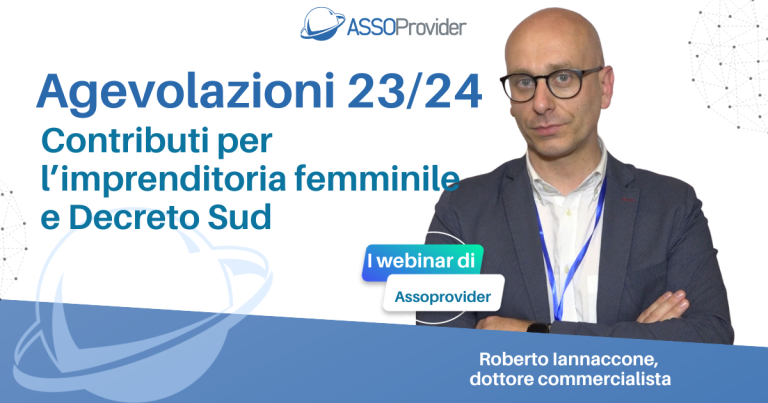
Assoprovider proposes a new webinar on facilitated finance, with the participation of chartered accountant Roberto Iannaccone, consultant of the association.
With Roberto Iannaccone, chartered accountant and Assoprovider consultant for facilitated finance, we discover the latest news on tax credits and contributions/subsidies that we can benefit from as Internet service providers.
The works are introduced by Assoprovider vice-presidents Antonella Oliviero and Marcello Cama.
To review the full recording of the event, including the "Questions and Answers" session, visit Assoprovider's official YouTube channel:
Contributions for Female Entrepreneurship
First of all, let's clarify that the funding call for female entrepreneurship is currently not active. However, with the new financial law, funds have already been allocated for its reopening and only final approval is awaited.
The call is aimed at both newly established businesses, including sole proprietorships initiated by individuals, and already established businesses, with no age restrictions. In particular, it is valid for:
- Cooperatives or partnerships with at least 60% women in their social structure.
- Capital companies where at least two-thirds of the shares and positions in the administrative bodies are held by women.
- Individual enterprises led by women.
This call represents a significant opportunity, as it offers contributions with accessible and not overly restrictive requirements. The sectors eligible for funding include:
- Production of goods in the sectors of industry, craftsmanship, and processing of agricultural products
- Commerce
- Tourism
- Provision of services in any sector
The sectors of primary production of agricultural products, fishing, aquaculture, and forestry are excluded.
In this prospectus prepared by Dr. Iannaccone, we see the two different possible types of contribution, for the Start-up of a new business or for the Expansion and consolidation of an already established business, with the respective amounts:
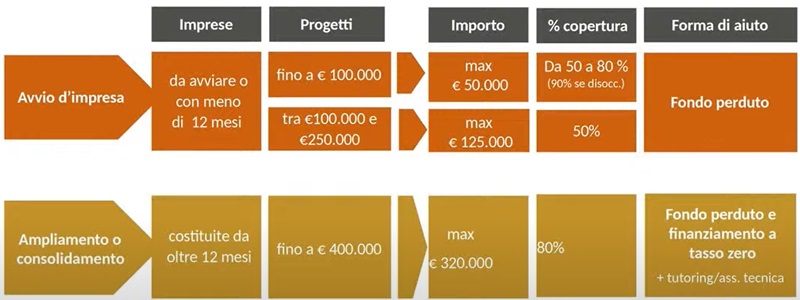
The proposed funding is interest-free or non-repayable, making the incentive particularly advantageous. Eligible expenses include
- Tangible fixed assets (machinery, plants, equipment, construction works) and intangible assets (software, patents, licenses, trademarks)
- Cloud services, functional to the core processes of business management
- Employees hired on a fixed-term or permanent basis
- Working capital (raw materials, consumables, services, rents, rentals and leasing)
Regarding the procedural process, after the application is submitted, automatic cross-checks are conducted with the business register and the data of the shareholders. Within 60 days, an initial evaluation and a merit interview are conducted. After an additional 30 days, a grant decision is issued. The project must be completed within 24 months for the disbursement of the contribution. In the case of business expansion, the interest-free loan must be repaid within a period of 8 years.
In conclusion, it is an opportunity not to be underestimated for companies that meet the eligibility criteria, with the possibility of accessing advantageous financial resources for the growth and development of the company.
Connectivity Voucher
Already discussed in the past, we now review the key aspects of the connectivity voucher, a measure aimed at stimulating the digitalization of businesses through access to ultra-fast Internet. This voucher is intended for micro, small, and medium-sized companies regularly registered in the Business Register.
The measure consists of providing a contribution, in the form of a discount, on the sale price of ultra-broadband Internet connection fees. A crucial point to highlight is the imminent deadline: vouchers can only be activated until December 31, 2023. It is expected that the measure may be renewed for the coming months, but this is not certain at the moment: therefore, we await further developments in this regard. The request can be submitted to any telecommunications operator (TLC).
Let's briefly recap the types of vouchers available:
- Voucher A1: Contribution of 300 euros for an 18-month contract for connectivity with download speeds from 30 Mbit/s to 300 Mbit/s.
- Voucher A2: Contribution of 300 euros, extendable up to 500 euros, for an 18-month contract for connectivity from 300 Mbit/s to 1 Gbit/s, with the possibility of an additional contribution to cover network connection costs.
- Voucher B: Contribution of 500 euros, which can be increased by up to an additional 500 euros, for an 18-month contract for connectivity from 300 Mbit/s to 1 Gbit/s, with a minimum guaranteed bandwidth of 30 Mbit/s.
- Voucher C: Contribution of 2,000 euros, which can be increased by an additional 500 euros, for a 24-month contract for connectivity exceeding 1 Gbit/s, with a minimum guaranteed bandwidth of 100 Mbit/s.
All the forms for operators are available on the Infratel website: https://www.infratelitalia.it/archivio-news/notizie/piano-voucher-fase-ii-imprese
At the moment, it is still unclear whether the contribution will be renewed for the coming months, so we await developments on the matter.
ZES area
Let's now move on to a detailed analysis of the recent developments concerning the Single Special Zones (ZES), especially in the southern area of Italy. Following the "Decreto Sud" of September 2023, there has been a significant transformation: from 8 distinct ZES, it has transitioned to a Single Zone, which involves the southern regions, namely Calabria, Sicily, Puglia, and Campania.
Entities that settle in this unique area will be able to benefit from significant advantages, both for investments and from a fiscal perspective.
For example, a tax credit is provided for investments in plants, machinery, and equipment related to significant projects. Specifically, entities that establish themselves in the ZES area can expand their activities, including the purchase of land and properties instrumental to the investment, provided that their share does not exceed 50 percent of the total value of the investment for which the incentive is requested. Consider, for instance, a total request of 200,000 euros: the acquisition of land and properties must not exceed 100,000 euros in this case.
The purpose of the regulation is, as the name suggests, to create special zones where companies can not only develop their business, which may have a productive purpose, but also offer services, as in the case of telecommunications companies.
Regarding the maximum measure provided for financing, the tax credit follows the guidelines of the Regional Aid Map 2022-2027 and is proportional to the share of the total cost of the acquired assets. For real estate investments, we are talking about purchases made from January 1, 2024, to November 15, 2024. The maximum limit for each investment project is set at 100 million euros, and the minimum amount of investments cannot be less than 200,000 euros.
Currently, we are awaiting the decree that will define the methods of accessing the benefit, the criteria and methods of application and utilization of the tax credit, as well as the related controls. Unfortunately, we must note that, despite the inclusion of many sectors in the benefits provided by the Decreto Sud, broadband has been excluded. At least for now: a possible revision of this decision is expected through the conversion decree.
Tax Credit Mezzogiorno – PON
Among the latest interesting opportunities for businesses, Dr. Iannaccone mentions the additional resources made available through the PON Enterprises and Competitiveness 2014-2020 ERDF.
These are funds made available to companies that have already benefited from the Bonus Sud tax credit for the purchase of capital goods. Access to the measure is possible if one complies with the criteria defined by the ministerial decree of 29 July 2016, namely:
- minimum investment amount (500,000 euros)
- exclusion of only the economic activities in the agriculture, forestry, and fish sectors
- localization in less developed regions
- traceability of investments to the application areas of the National Smart Specialization Strategy
Companies that meet these requirements have the opportunity to submit a request to the Directorate General for Business Incentives to obtain co-financing with PON resources. The Ministry of Economic Development will evaluate the provisions established by the decree and the reporting obligations, thus deciding whether or not to grant additional financing through regional funds. It is important to emphasize that, in the case of projects not admitted, the previously obtained tax credit will not be lost.
For the management of this facilitative tool, specific agreements have been signed between the Ministry and the interested Regions, such as Molise, Calabria, and Campania. This is a significant opportunity for companies that meet the aforementioned criteria, offering them the possibility to access additional financial resources to support and enhance their investments.