

Designed by an Italian professor, Algorand overcomes the issues of first and second-generation blockchains. Let's explore how and some practical applications, such as Assoprovider's new LoRaChain project.
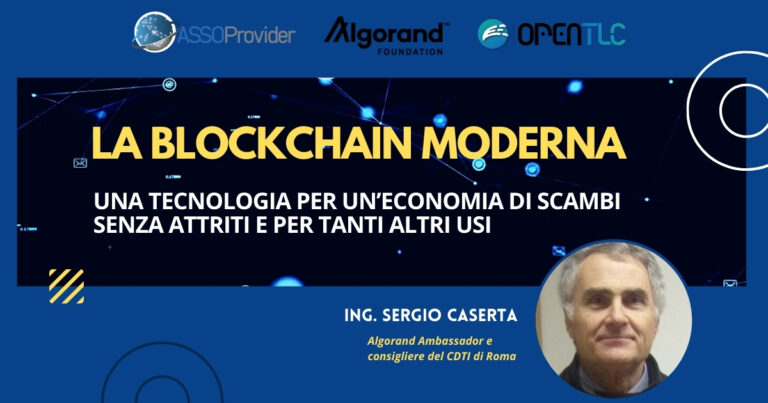
Following the great participation in the two webinars on the European Communications Code (summaries can be found here and here), Assoprovider has launched a new event, this time focused on Blockchain.
As Marcello Cama, vice president of Assoprovider, mentioned in the introduction, the association of independent providers "has all the characteristics and interest, as the main network of telecommunications in Italy, to delve into the aspects of the 'blockchain', which today is surpassed by the advent of Algorand, which, in addition to being a blockchain, is a foundation that provides development tools, funds, and technical support, even for us proximity operators."
The presentation of Algorand is conducted by engineer Sergio Caserta, board member of CDTI of Rome, "Algorand Ambassador," Italy manager of Vanguard Communications Europe and value maximiser of MirrorWave.
Blockchain: history and limitations
The intervention opens with a quick summary of the main milestones in the history of Blockchain, from its inception in 2008 by the mysterious Satoshi Nakamoto, to the subsequent improvement introduced by Vitalik Buterin with Ethereum in 2013.
To delve deeper into the functioning and revolutionary scope of Blockchain, watch the speech by Assoprovider president Dino Bortolotto during APRO18:
More than on historical milestones, Caserta focuses on the limitations of first-generation blockchains, on which Bitcoin is based, and second-generation (Ethereum).
Both technologies are based on a consensus protocol called proof of work: essentially, it is a rule for validating the writing of the next block in the distributed architecture of the public Blockchain. The proof of work soon proves to be limited because, we can say, "it does not fulfill all its promises" of scalability, security, and decentralization: it is the trilemma already codified by Buterin, which explains how we can only have two out of three of the aspects considered within first and second-generation Blockchains.
This is because, explains Caserta, "proof of work is unsuitable for applications with high volumes and low transaction response times. It also relies on miners, which are terribly energy-intensive, consuming as much as a small city..
The first response to Buterin's trilemma came with the advent of private Blockchain, which, however, is a sort of "oxymoron," Caserta further explains. New consensus protocols then emerged, including bonded proof of stake, delegated proof of stake, and Pure Proof of Stake – PPoS, the most interesting today.
PPoS was conceived by Professor Silvio Micali, a Sicilian who is currently a professor at MIT, as well as the founder and president of Algorand, the Third Generation blockchain.
Algorand: birth and characteristics
Essentially, first-generation technologies ensure either high security at the expense of decentralization and scalability (as in the case of Bitcoin and Ethereum, which do not allow many transactions), or they enable the creation of decentralized and scalable technologies but at the expense of security (bonded and delegated proof of stake, where nodes can be attacked or manipulated).
Algorand overcomes Buterin's trilemma through PurePoS, meeting all three requirements of scalability, security, and decentralization, through complex mathematical theorems (described on the Algorand website). Essentially, Caserta explains, the nodes participating in the definition of the next block are selected randomly each time: each node participates in a personal "lottery." If it wins, its node is considered.
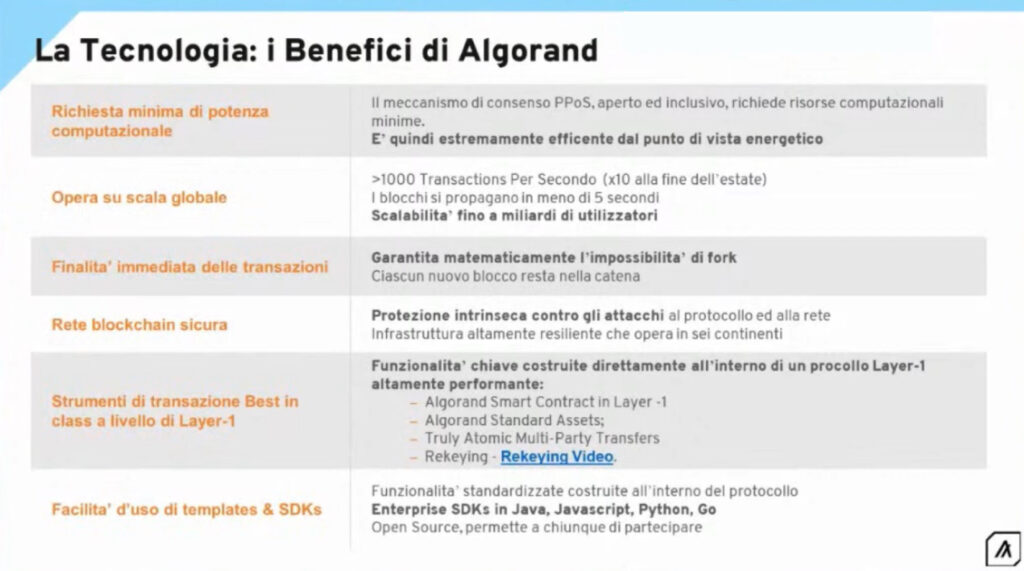
The result, essentially, is that Algorand promises to be scalable on a global level, meaning it has the capability to include billions of transactions from billions of users, with very rapid response times (currently, response times are under 4.5 seconds and will reach approximately 2.5 seconds by the end of 2021), while remaining secure and decentralized, at very competitive costs: today, each transaction costs 1 thousandth of an Algo (the cryptocurrency running on Algorand), which corresponds to about 1 thousandth of a euro.
In the slide, some of Algorand's strengths:
Algorand was officially launched in 2019, although work began two years earlier, and it has already gathered an interesting number of transactions, as we will see. Among the virtuous examples, Caserta cites the tokenization of copyright by SIAE: essentially, in collaboration with Algorand, the Società Italiana degli Autori ed Editori has transformed the rights of over 95,000 SIAE authors into NFTs (non-fungible tokens, specific tokens that allow for the unique ownership of an asset).
The Algorand ecosystem
Today, Algorand already has 9 million users, with more than 500 companies using the platform, nearly two thousand nodes, and over 12 million blocks. Algorand, in fact, presents itself not "just" as a Blockchain, but as a true ecosystem.
The Algorand Foundation has indeed created an open source and "permissionless" platform, which means that developers and companies can use the Blockchain independently, without requiring permissions from the Foundation.
As part of promoting the potential of technology, the Algorand Foundation has also launched a series of funding programs, including grants, for those intending to develop applications based on Blockchain:
- Ambassador Developer Program (DevAms), dedicated to developers who want to become "ambassadors" of Algorand. More information at the link: https://algorand.foundation/developers/dev-ambassadors
- Developer Award Program, dedicated to developers who want to create new solutions functional to the growth of the ecosystem, also in exchange for cash prizes: https://algorand.foundation/developers/developer-incentive-awards-program
- AlgoGrants, dedicated to research, development of tools and infrastructure, application development and use cases, training and communication: https://algorand.foundation/grants-program/algorand-foundation-request-for-funding
- Business accelerators, a program dedicated to startups in Europe, Asia, and South America: https://algorand.foundation/ecosystem/accelerator
LoRaChain, the new project launched by Assoprovider
At the end of engineer Caserta's speech, Marcello Cama takes the floor again to present the new LoRaChain project, an evolution of LoRaWan, in which, Cama explains, "we have connected IoT and Algorand, making a concrete choice. He then gives the floor to Marco Caldarazzo, CEO of Metrowimax, and the person responsible in Assoprovider for the LoRaWAN project.
In essence, LoRaChain will be “a confederated network to manage IoT and sensors present in the territory. If until now the technical problem in implementation was managing transactions between the various components of the network, we have found an ideal solution in Algorand, a more streamlined blockchain, which allows us to create a marketplace where the demand for coverage meets the supply of coverage, thanks to the technology devised by Professor Micali.
Caldarazzo then illustrates the advantages of LoRaChain:
- It is possible to share operators' assets, such as gateways, but not only
- Revenues are based on useful traffic
- The platform allows for the creation of a true market among operators, in a marketplace also open to owners of physical infrastructures.
- The issue of roaming within the platform is overcome.
- The exchange prices are set in complete freedom by the members of the platform.
This is a very attractive opportunity because, as Caldarazzo explains, the Internet of Things market will become increasingly important in the coming years, particularly in the LoRaWan segment, which will exceed 600 million euros within five years.
The blockchain Made in Naples
The last guest of the event, Felice Balsamo, former Assoprovider advisor, as well as promoter and coordinator for the Municipality of Naples of the Naples Blockchain project.
Balsamo shares his experience: since 2018, Naples has been one of the first cities in the world to start using blockchain in the administrative field. The first project implemented was the tokenization of book vouchers, uploaded on Ethereum for the first time, instead of the more common Excel files.
But the most interesting project involved the participation of many trade associations in the city, with the aim of making merchants aware of the potential of technology and promoting the use of cryptocurrencies. Among the most interesting initiatives described by Balsamo, the reward system for museum bookings in the city:If you book a visit to the museum and actually show up on site, you will receive as a gift 1 or 2 tokens to use in our network of participating businesses., explain.
To review the full video of the webinar, you can register on our Apeventiweb platform at the link: https://apeventiweb.it/la-blockchain-moderna-una-tecnologia-per-uneconomia-di-scambi-senza-attriti-e-per-tanti-altri-usi/